วันจันทร์, กรกฎาคม 30, 2007

Welcome to global warming awareness 2007.


Welcome to global warming awareness 2007.

Well I accidently felt over this seo contest surfing the internet and on normal circumstances I would nerver participate in such at thing as the “global warming awareness 2007” contest, but by clicking around the sites in the contest, I decided that maybe this was right for me.
The thing is that the keywords, global warming, and awareness said something to me, and it hurts me to see some peoples reaction, to this contest and the keywords to it. I was shocked when I visited this site (I wont link to it ) globalwarming-awareness2007.isabloodycloaker dot com) This stupid moran have got this whole thing wrong, because I think that the global warming keywords are a totally great idea. Now you are probably thinking why is that. ?
The world seo championship has here by added a totally new thing to the contest by choosing these keywords, and that new thing is responsibility ! and I bellive that it is time that what all start to take responsibility to our actions in live, and to this contest. it is our responsibility to make our global warming awareness sites as informational as possible on this issue, so that when people surf the net, looking for global warming sites, and they enter one of the sites from this contest, they will get what they have been looking for, and not some crap site written by a totally idiot.

I am not a professor in global warming, but I will tell some of the facts I know, and besides that I will try to collect as much information on the awareness of the global warming, and post it here on this page.

A couple of weeks ago I went down to the gas station in my neigbor hood to rent a film, and on the dvd staples I saw a film called AN INCONVENIENT TRUTH.
I had seen some commercials in the televison for this film, and understood that this was a movie about global warming and on planet crisis. So I thought why not ? And rented it.
And I must admit that I was totally shocked when I saw this film. If you havent seen it I highly recommend that you do ASAP. The movie is made by former Vice President Al Gore, and I must admit that I have become a fan of this man, and his awareness of the global warming situation on our planet earth. The main reason why I was so impressed Al Gore, is that he takes responsibility for the global warming. As I look on Amercia they have always been the good guys (and always make it look that way) especially when it comes to the us government. But in this movie Al Gore speaks straight from his heart, and tells that America is the worst country, when it comes to creating global warming, and pollution in all kinds. And that is what I call taking responsibility, and if we all learn to do that everything will be way easier to manage.

I will be updating this site on a daily basis. If you are a professor or just a person who are aware of the global warming situation and feel that you would like to share something with other people do not hesitate to mail me my mail is elgynventegodt@hotmail.com you are also more than welcome to use the forum. All the best Michael

Global warming is a much disputed issue that can leave the average individual quite confused. Unfortunately, there are no straightforward answers. For those of us who are not scientists, it is easy to be overwhelmed by the contradictions. It is much more convenient to just give the whole thing up and enjoy the weather or not, as the case might be.

However, just because you are not a scientist does not mean that you must be misinformed or uninformed. There is a middle ground where you can get a reasonable perspective on global warming and global climate change.

Climate science is very complicated and the controversy surrounding it is only natural. It is in the nature of science to evolve and change. Through all the debate in climatology, a consensus is now beginning to emerge which accepts that our planet is experiencing the effects of global warming.

The following article gives a brief outline of the history of our planet, its current state, and what you may expect in the near future. The facts listed here are based in climatology.

Greenhouse Effect

Though this term is often tossed around as a problem, the fact is that the greenhouse effect is a natural aspect of the Earth's atmosphere and more than that it is a key component of the climate as we know it today. Left in its natural state ,the greenhouse effect would keep the average temperature at around 59 degrees Fahrenheit (15 degrees Celsius). Without the greenhouse effect, the Earth would probably not support the life we know as the temperature would be 0 degree Fahrenheit (18 degrees Celsius).

The term greenhouse effect comes because the effect is propagated through greenhouse gases with Carbon Dioxide (CO2) forming the biggest contributor. Greenhouse gases trap the heat that the planet receives from the sun ,thereby leading to a livable atmosphere and a stable climate. Carbon dioxide is produced through animal respiration. This mixes into the atmosphere and is absorbed by plants that use photosynthesis and release oxygen. The same oxygen is inhaled by animals and this cycle goes on in perpetuity.

The Human Contribution

Humanity has always relied on fuel of some sort but it is the beginning of the industrial revolution around 1750 that we started burning fossil fuels with utter disregard for consequences. Coal, oil, and natural gas are the popular forms of fossil fuels and all of them, when burned, release CO2 into the atmosphere. Besides CO2, other human activities release other greenhouse gases. Agriculture leads to methane and nitrous oxide excess while aerosol propellants produce CFCs (Chloroflourocarbons) that are directly damaging to the ozone layer. However, when viewed in terms of sheer volume nothing compares to excessive CO2 and its effect on the atmosphere.

At the beginning of the industrial revolution, CO2 had a concentration of 275 parts per million as a global average. Today, that same value stands at 350 parts per million, a staggering 30% increase that is increasing. The second half of the twentieth century has witnessed a further acceleration in this phenomenon.

Data from all over the world shows that the amount of CO2 in the atmosphere is steadily increasing as more and more countries are industrialized.

Global Temperature

Recording temperature at one place is quite easy but how does on figure out the global temperature?

There are temperature records from many locations all over the world that are more than a century old. As is to be expected, these records show a huge variation depending on where the data was recorded. However, between all the confusion there is still the fact that everywhere the temperature seems to have gone up by 1 degree Fahrenheit (or ½ degree Celsius) and this change is most precisely seen since the 2nd half of the 19th century. A 1 degree change may not sound like much but it has some huge effect on global climate.

However, there remains the problem of getting accurate data records from all over the world in order to arrive at a reasonably precise figure for global temperature. Some of the problems in doing this are as follow.

* The thermometer has undergone several changes and today it is far more accurate then it was a century and a half ago. So how reliable are the temperature recordings from back then?


* There is something known as an "urban heat island" effect. This basically involves land use and it is known that land use has an effect on local temperature. Cities are hotter than the surrounding countryside. This means that with urbanization a location might record higher temperatures that are not related to global warming. Locations for data recording change ,so their reliability becomes questionable.


* Most records are maintained in industrialized locations. This is known as a geographical bias.


These factors tend to confuse the whole global warming issue because you never know if the data is reliable or not.

This is why the 1 degree change is not taken from raw data but is adjusted to compensate for these factors.

Climate Models

Climatologists use CGMs (Computer Generated Models) in order to predict the change in global temperature based on an increase in greenhouse gases. The CGMs suggest an increase of 1 degree Celsius that is not so far from the actual increase reported but still double and hence a cause for worry. This discrepancy has been among the leading causes of controversy with global warming.

However, science is an evolving mechanism and newer climate models along with modern observations of changes to the Earth's environment have eliminated the reluctance of most climatologists towards global warming.

It is difficult to ignore the effects of global warming when there is clear evidence for rising sea levels, receding glaciers, migrating plants and animals, dying coral reefs, reduced temperature fluctuations, and unexpected and frequent precipitations. All of these events are being recorded all over the world to varying degrees.

Most climatologists are now of the opinion that we are indeed experiencing the ills of global warming.

The next obvious concern is the expected global climate change and its effect on the environment and on the future of humanity.

Politicians Who Make Big Political Announcements On Comedy Shows


John McCain announces for president on the Late Show With David Letterman.

Arnold Schwarzenegger announces for governor on The Tonight Show With Jay Leno.

John Edwards announces for president on the Daily Show with John Stewart.

That just leaves Al Gore announcing for president on The Weather Channel.

World View of Global Warming


The Arctic and Alaska

The Arctic is thawing very rapidly, documented by new reports from scientists and arctic natives. The Arctic Climate Impact Assessment was released in late 2004, and shows changes from the ice at the North Pole to animals and human settlements. More recent reports from Greenland show outlet glaciers moving meters per hour and rapidly thinning. The Arctic Ocean ice cap is shrinking in summer to the smallest it has ever been in modern measurements, and even winter cold has not been refreezing it as extensively as before. That sea ice is habitat for the polar bear. Declines in bear nutrition, birth weight and survival have moved the U.S. government (urged by three environmental groups) to propose the bear be named a species threatened with extinction.

Below and on linking pages, are reports on the latest science and warming effects across Alaska and parts of the Arctic. For more on Arctic natives, please see the Arctic page. Also see Glaciers for more on Greenland and Alaska glaciers.

Pushing the Boundaries of Life: Alaska

caribouThe listing of polar bears as threatened under the U.S. endangered species act will name global warming as the main threat, a first. The reduction of the permanent Arctic sea ice by 14 percent since the 1970s is causing not only feeding and breeding difficulties, but also drownings and apparent cannibalism among bears. The listing should be official by the end of 2007. For more information, see Center for Biological Diversity. Scientists are just beginning to see the effects of climate change on other Arctic wildlife. Caribou give birth at specific times and locations, making them susceptible to changes in weather and vegetation. Studies show that the tundra is now blooming slightly earlier and that it is affected by drier summers and heavier winter snow.

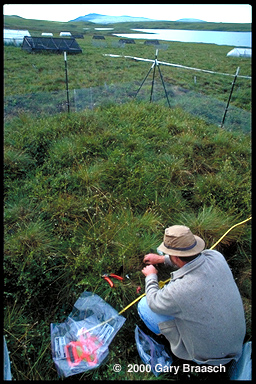
Biologist Gus Shaver at Toolik Lake, AlaskaBiologist Gus Shaver at one of his experimental plots at Toolik Lake, Alaska, monitors increased birch growth due to experimental fertilization and global warming. Shaver says the results of his experiment suggest that warming eventually will promote the growth of birch at the expense of sedges, forbs, and other plants that caribou and other wildlife favor as food sources. During an initial 15-year study (1981-95, which included the warmest decade on record) the sedge Eriophorum decreased by 30 percent while birch biomass increased, even in control plots. In 2002 Shaver reports the growth of birch has changed the ecology of tundra in some plots by covering and killing moss with large amount of leaf litter.

The great loss of ice from the Arctic, which includes not only the polar sea ice cover but also thawing glaciers and tundra permafrost, has other major implications. One of the most important is that dark open water and tundra absorb much more solar heat than white ice and snow. This is a "feedback loop" that will make changes happen faster.

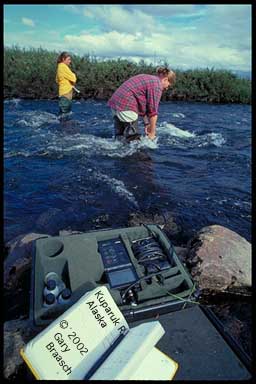
Another large effect in the Arctic is a freshening of the Arctic Ocean. In late 2002, geochemist Bruce Peterson of the Marine Biological Lab in Woods Hole, MA, and his collaborators in the US and Russia, showed that the major rivers of Siberia and Eurasia are discharging much more water now than in the 1930s. This not only meets the predictions of an effect of climate change, but indicates the scale of change affecting the Arctic.

In late 2002, geochemist Bruce Peterson of the Marine Biological Lab in Woods Hole, MA, and his collaborators in the US and Russia, showed that the major rivers of Siberia and Eurasia are discharging much more water now than in the 1930s. This not only meets the predictions of an effect of climate change, but indicates the scale of another source of added fresh water into the Arctic.

So what is happening to all this fresh water from increased river flow, melting glaciers and shrinking sea ice? It mixes into the Arctic Ocean and the less salty Arctic water flows south around Greenland, to the source of some of the greatest ocean currents.

The interplay of ocean currents in the North Atlantic is very important to climate. Here, between Labrador and Scandinavia, the Gulf Stream brings a huge flow of water from the south, helping warm Europe as it gives up its heat. This water sinks as it cools, to flow back south again in the deep Atlantic. This plunging down of millions of tons of water per second helps propel what has been termed the Great Ocean Conveyor, a system of huge currents transferring heat throughout all oceans and influencing climate.

One key to this system is that the Gulf Stream water becomes more dense as it gives up heat, and it sinks. But the added fresher water coming down from the Arctic is much less dense, and floats on top of the North Atlantic.

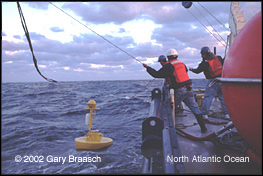
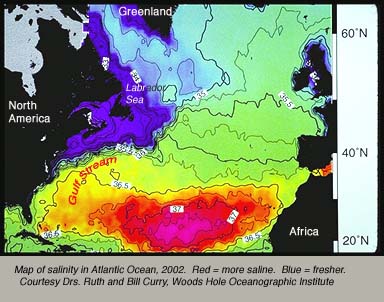
Is there enough new fresher water from the Arctic to prevent the Gulf Stream water from sinking to help drive the conveyor of currents? According to recent studies by Dr. Ruth Curry and colleages at Woods Hole Oceanographic Institute, there is more fresher water in the area than ever measured before. Already sinking rates in some locations are 20 percent less than in the 1970s.

The northern waters are getting fresher while the southern waters (near equator) are increasing in salinity. Curry says this indicates a change in the climate with more precipitation and ice melt in the north and much stronger evaporation in the south. In other words: "Global warming."

Scientists are concerned that the point at which the current Conveyor does begin to slow may be near. Other current research shows the Gulf Stream is not the prime moderator of European temperature (westerly winds play a larger role). Yet climate in Europe and NE North America could chill if the ocean current slows dramatically. This is the jumping off point for a recent Pentagon planning report about possible international unrest caused by climate change, and for the movie "The Day After Tommorow." Scientists say disruptive change is coming -- but much more slowly than depicted in these scenarios.

Reference 6

More Climate Change in Alaska 2 >>

Photographs from the World View of Global Warming are available for license to publications needing science photography, environmental groups and agencies, and other uses. Stock photography and assignments available.

Please contact requestinformation@worldviewofglobalwarming.org or Gary Braasch Photography (503) 699-6666.

Use of photographs in any manner, in part or whole, without permission is prohibited by US copyright law. These photographs are registered with the US Copyright Office and are not in the Public Domain.

Diesel: Global Warming, London


Global warming ready

Advertising Agency: Marcel, Paris, France
Creative director/Copywriter: Frederic Temin
Art directors: Nicolas Chauvin, Romin Favre
Photographer: Terry Richardson

Global warming may have permanently damaged reefs


A dead reef in the Seychelles.

The effects of global warming upon coral reefs have been more devastating than previously believed, according to the first report to show the long-term impact of rising temperatures on fish and invertebrate life.

According to a 50,000 square metre study of 21 sites on the inner islands of the Seychelles undertaken in 1994 and 2005, large areas of coral reef and the organisms that live there, may have been permanently lost due to global warming.

The study, which was undertaken by an international team of biologists, is the first to show the long-term effects of the 1998 heatwave which caused sea temperatures in the Indian Ocean to rise so high that they killed more than 90% of the corals in the inner Seychelles.

Collapsing reefs

Their paper in the Proceedings of the National Academy of Sciences says that while the 90% loss of coral cover was dramatic enough in itself, the long-term prospects are more bleak and many reefs have been unable to recover and many have collapsed into piles of algae-covered rubble.

The study says that the collapse of reefs, which are in part held together by corals, has led to a drop in the amount of food available and shelter from predators, which has had a knock-on effect to the other reef organisms.

The effects of global warming have not just been damaging corals, either. Four fish species, including two labrid wrasses, a Butterflyfish and a damsel are already believed to be extinct in the area, while others have dropped to critically low levels.

Lead author, Nick Graham of Newcastle University's School of Marine Science and Technology said: "Reefs can sometimes recover after disturbances, but we have shown that after severe bleaching events, collapse in the physical structure of the reef results in profound impacts on other organisms in the ecosystem and greatly impedes the likelihood of recovery.

"Unfortunately it may be too late to save many of these reefs but this research shows the importance of countries tackling greenhouse gas emissions and trying to reduce global warming and its effect on some of the world's finest and most diverse wildlife."

In America, Global Warming Doesn't Even Register.

gratuitous picture of cute animal affected by global warming. suck on that, Cuteoverload!

Click on the amazing graph from yesterday's New York Times article on American opinion about global warming.(below the fold) It doesn't even register as a serious issue. Even when asked about environmental issues, it rates near the bottom, above acid rain and below the ozone hole. We think that Green is going mainstream in America as we read our Vanity Fair, Elle, Time and even Wallpaper this month, but we may be wrong. We are not even on the radar.
From the Times article: "I wish I were more optimistic of our ability to get a broad slice of the public to understand this and be motivated to act," said David G. Hawkins, who directs the climate program at the Natural Resources Defense Council, a private group. In an e-mail message, he wrote: "We are sensory organisms; we understand diesel soot because we can smell it and see it. Getting global warming is too much of an intellectual process. Perhaps pictures of drowning polar bears (which we are trying to find) will move people but even there, people will need to believe that those drownings are due to our failure to build cleaner power plants and cars." ::New York Times

Last night's TV: The Great Global Warming Swindle


The Great Global Warming Swindle on Channel 4.

"We're heretics! I'm a heretic. The makers of this programme are heretics." Nigel Calder is explaining how the world sees scientists who deny global warming. Channel 4's The Great Global Warming Swindle made one interesting point - that scientists are not unanimous in their assessment of the connection between global warming and CO2. Most say the second causes the first; a few say the first causes the second. Interesting, huh? Academics in not-all-thinking-exactly-the-same-thing shock. The amazing thing about global warming is not that someone from Winnipeg University disagrees (if you've ever been to Winnipeg, you will know what it means to be forced by your academic qualifications to live there); it's how many people don't disagree.

Sorry, I am just rolling over and handing the refuseniks a piece of their most powerful weaponry - when everyone agrees, why, that's like when we thought the world was flat! Only a few brave voices stood up, and they were ridiculed! I actually had this argument on the Daily Politics with Peter Hitchens. "You can't seriously be contending," said I, "that just because all scientists say you're talking rubbish, that de facto turns you into the brave, lone voice of truth?" (I am buffing my prose a bit, I admit.) "That's the trouble with you Guardian journalists! You only talk to each other!" he retorted.

Calder, incidentally, is billed as the "ex-editor of the New Scientist"; to clarify for a second what they mean by "ex", he was the editor of a non-peer-reviewed journal that, under his relatively short tenure beginning 1962, was five years old. That's like accepting the ex-editor of a student fanzine as a leading authority on Mahler's experiments with harmonic dissonance. Here are the other core arguments against global warming: one, that the earth's temperature is always changing, and we had a mini-ice-age only a couple of hundred years ago; two, that the environmental lobby is just trying to scam the developing world out of developing, by forcing it to use solar power; three - this is a new one on me, I have to admit - that a new breed of "environmental journalists" has such a vested interest in there being an "environmental" case to answer that they effectively bully editors into printing stories that aren't true (they definitely have a point, here - a cancer journalist of my acquaintance recently ripped up the cure for cancer and flushed it down the toilet, because she worried that she might have to move into virus-reporting, and one's 30s simply isn't the time to retrain).

I know Channel 4 has a new remit of its own devising, to make trouble and stir up hornets' nests and all that, but what this amounts to is not mischievous subversion, it's just more of that age-old Fox News formula: take a surprising fact that might make people think, but won't make a programme on its own; gather together some bouncy commentators, stick a snooty voice over the top, create a sense of conflict without properly interrogating the positions taken within it, and aah, Bisto!, you have successfully brought to the world the smell of confusion.

What's a layman to make of all this? Oh me oh my, I'm too confused, I can't make anything of it! I'm just gonna take me a lovely holiday in the sun instead, and to heck with the environmental consequences which many leading people from Winnipeg have already told me aren't true. It's incredibly tacky, global warming aside, this cheap-shot attitude to what can be presented as truth. You can feel its insincerity, even before some frothy, patronising "scientist" bounces on to the screen to say: "If you had x-ray eyes, what appears as a nice yellow ball would appear as a raging tiger!" (That is Calder again. Talking about the sun.)

"You can't seriously be saying that the leftwing doesn't have its own propaganda," a young woman pertinently challenged Al Franken in BBC4's Storyville: Al Franken - God Spoke. I expected him to be annoying, but in fact he responded rather charmingly. She was pretty, I guess. Good God, though, it gave you a horrible insight into what it means to be a polemicist in America. Al Franken, if you remember, wrote Lies and the Lying Liars who Tell Them, whose subtitle - a Fair and Balanced look at the Right - gave the abovementioned Fox News cause to sue him. "Fair" and "balanced" are their words, apparently. Franken is not without his faults but the man has cojones. He takes on Ann Coulter. Nobody in their right mind would do that. Smarting, she emerged from the debate and a weeny sycophant ran over: "He is, like, totally obsessed by you! Did you hear what he said about your hair!" Coulter, fresh from defeat, stuck out her chin while her ego recharged.

It must be like playing Grand Theft Auto, keeping these people maintained. Storyville rocks. It should get all the licence-fee money.

‘Vertical Farm’ Skyscrapers Could Help Fight Global Warming: Professor Believes


A vision straight out of ‘Futurama’ gives birth to a Columbia professor’s belief that it is by converting the skyscrapers into crop farms, global warming can be reduced, making New York cleaner.

Here’s how it might work

Dr. Dickson Despommier, a professor of environmental sciences and microbiology at Columbia University thinks that “vertical farm” skyscrapers could help fight global warming.

The concept is like, for example, a cluster of 30-story towers on Governors Island or in Hudson Yards produces fruits, vegetables, and grains and at the same time it also generates clean energy and purifies wastewater.

According to Despommier, it is roughly 150 such buildings, which are capable of feeding the entire New York city for a year. He believes that by using current green building systems, a vertical farm can be made self-sustaining. It can, at the same time, produce a net output of both clean water and energy.

The vertical-farming concept could take a working group of agricultural economists, architects, engineers, agronomists, and urban planners five to ten years to figure out — how high-tech agricultural practices and the latest sustainable building technology can be married successfully and sustainably.

It is only by allowing Earth’s significant portions of farmland to return to forest, climate and weather patterns can be stabilized. It is only by allowing forests to regrow in place where crops are now cultivated, carbon dioxide reduction in the atmosphere is possible
, he believes.

Think outside the globe

BIG BANG

This piece is written as a tongue-in-cheek rebuttal to the way out theories that defy logic. Theoreticians should make more of an attempt to make their theories, no matter how accurate, at least portrayed as something that �could� be right. I believe in the absolute properties of math, however, just like computer programs, sometimes garbage in equals garbage out. Over the course of time, we have got the unified theory, the cold dark matter theory, wormholes, and a variety of other so called theories. Most of these theories were promulgated to support other weak theories. Egos get in the way, as well as reputation and we are meant to slurp up these concoctions as if they were buttery syrup and we had biscuits, asking for more.

Maybe the paradigm of the big bang is correct, but maybe it isn�t. For this piece I am going to assume that it is a valid beginning for the universe. With that explanation, I give you my version of the �Big Bang�, which is at least an attempt at logic. The illogical part is the acceptance of a mysterious singularity lacking any explanation of where it came from or what could have destabilized it. Providing that the paradigm of the �big bang� is correct, it would be logical to assume that once matter becomes that compacted, it starts to transform into energy, thus loosing mass, and less mass equals lower gravity. Then we have set the stage for the great expansion. This is just my musings, but there probably is a logical explanation for the destabilization of the singularity.

Once you get past that bit of nonsense, then I present my version of what happened from the time of the great expansion until we have galaxies. Enjoy! :-)

Big Bang According to Robert

Whatever it was, according to the theoreticians, it wasn�t very big. Somewhere in time, the thing couldn�t remain in the form it was in, so it started expanding. (The big bang.) The scholars are vague about what caused the instability; all we can surmise is that it started expanding fast enough to be classified as a bang.

At this point, it is fair to point out that the singularity as the big bang theory proposes, contains the total universe. All of the matter of the universe, and according to some, space itself was contained in this single entity. What is also very visible and important about the singularity is that it is not able to maintain itself in this state. Thus it is an unstable entity. Relate this to the theory of the black holes speculated by scholars, that gravity is so strong that light cannot escape. Matter is compressed to the point that molecules no longer exist, just primary elements of molecules with no respect for the normal space between these basic elements. What the �big bang� theory tells us, is that no amount of matter so compressed is stable. If a black hole were to keep adding matter to itself, there is no point at any stage of the matter accretion that would be stable. Think about it, gravity cannot be stronger than with a body containing all the matter of the universe. It is a maximum statement for gravity, and yet it still could not hold the singularity together. Therefore gravity cannot be the irresistible force that it is made out to be. Black holes may exist, but they cannot be stable. Gravity by any explanation, even to the point of holding the entire universe, cannot be absolute. The �big bang� settles the question absolutely. We pick up this narrative with the expansion of the singularity.

Did I say expansion? That�s what we are told. Whenever you look at a stick of dynamite exploding using a high-speed camera, that�s what you observe; expansion of the reaction. It is necessary to grasp this concept, as opposed to an instantaneous blast.

Lets call the expanding entity something, because describing the thing we are talking about whenever we talk about it, isn�t very efficient. For lack of a better term, I�ll call it the universe.

Remember our observation is happening fast enough so that we can see what is happening. The only constraint on the universe now is the weakening (But still strong) gravity of its former self. The expansion of the universe is causing it to break up. The pieces are different sizes, some large and some small. Even these fragments are still expanding, and fragmenting further. Still smaller fragments of these fragments are taking off in all directions. Try and picture a fireworks display where the fireworks are blasted into the sky, and then in turn, they explode in the air with fireballs going off in all directions. This is what is happening to our universe fragments. Relative to each other, the fragments and sub-fragments are going every which-a-way, but taken as a whole, the whole batch is moving away from the initial point of expansion.

That�s pretty much the big picture, but there was a lot going on and now we will back the tape up for another view of the universe at the time of the great expansion. The universe as we know it was compressed into a very small body. Gravity was unimaginably great surrounding the universe at this time. It was probably the force that held everything together. (Although it is not a certainty, but it is one of those things that we will assume for this article.) Visualizations are difficult here but try to mentally imagine a piece of dry ice in a pressure cylinder. Reduce the pressure to 1 atmosphere (The same pressure we live in normally) you will observe the dry ice giving off a haze that is drifting away. Now increase the pressure, as the pressure increases you will reach a point where the dry ice is stable and no longer giving off gas. This is the predicament of the universe fragments, as they raced away during the expansion. The further away they traveled from each other, the less the force (gravity) that held them together. These fragments of very dense material began acting like the dry ice at atmospheric pressure. They were fizzing and fragmenting further. And, with every release of sub fragments, the gravity produced by these smaller chunks of material got smaller.

There are still fragments of the great expansion in existence. Every galaxy still has, or once had, one at its core. These fizzing, pin wheeling, fragments disbursed the elementary particles that created the stars that make up each galaxy. Spewing out the elementary particles to coalesce into stars that in turn through fusion create the larger atoms that we are familiar with.

Currently, physicists take the opposite view about the heavy masses at the center of the galaxies. They contend that the galaxy centers are accreting mass. This theory does nothing to explain what happened to the concentrated mass that started the great expansion. What forces would have concentrated the matter into the billions of galaxies? Just think about the scenario of the original singularity that expanded to form the universe. Listening to the explanation of the physicists, you would have to believe that primary particles were distributed evenly during the expansion, and somehow they were being lumped into galaxies as the universe was expanding. No mention is made of the fragmentation of the original mass. What happened to the original fragments and sub-fragments?

There is also evidence of galaxy collisions. But I submit if you shoot a shotgun, the pellets are on an expanding trajectory, but not on a collision course with one another. A practical explanation for the collisions is the one given above where the larger fragments are further fragmenting into all directions creating a condition that could foster collisions. These fragmenting pieces accelerated away from the original expansion point at a high rate of speed, so that any backwards fragmenting would not be of sufficient speed to actually travel backwards, relative to the direction away from the original point of expansion.

After the larger fragments have degraded into masses of a size that can no longer support fragmentation, they become just fizzlers, spewing out elementary particles, similar to an Alka-Seltzer in a glass of water. The mass of these pieces cannot be overstated, but being naturally unstable, particles are escaping. So at present, these fragments of the singularity are still spewing their volume and birthing stars.

The escaping particles form hydrogen in great quantities and as this gas accumulates, stars are formed. Some of these stars are pretty massive and are short lived in terms of star life. They die like all stars, but not before fusing a lot of elements and expelling a lot of unused hydrogen from its halo. The really massive stars may collapse into a super dense matter called a black hole that will return, through its radiation and instability, primary particles to once again escape and form hydrogen. A lot of this used star material is accelerated in a direction away from the galaxy center where it combines with ejected material from other dying stars to form other stars. Some of the heavier ejected, fusion created, material forms material disks around these stars. This material is heavier now, born of the fusion process, and will collect together to form planets. The process eventually builds the star disk of a galaxy. (Given enough time.) The size of the galaxy disk is an indicator of how large the initial fragment was that created the galaxy. Left alone, a galaxy will assume the classic spiral shape, but these shapes can vary with near misses and collisions with other galaxies.

I now conclude this narrative. Hopefully, you enjoyed it as much as I enjoyed writing it.

Robert Gross

COMMENTS Your Feedback is Important to Us

Home

Top of Page

Global Warming Rewrite

Global Warming Icon

Eating Crow: Nobody likes having to write a retraction, but a rewrite is in order to correct my first article about 'Global Warming'. Life, if nothing else, is a learning experience. My assumptions about the effects of CO2 on our climate were in error. Like most people I accepted as 'common knowledge' that man was wrecking the ecology and causing the global catastrophe of 'Global Warming'. Chief among the cause was our use of fossil fuels, and their subsequent discharge of CO2. Those conclusions were premature, and I now want to share with you additional findings that I thought were compelling enough to do a rewrite of my previous article.

Considering Mars: Mars stands out like a glittering jewel as an example of why we should not get too excited about CO2 as causing the Earth to warm up. The atmosphere of Mars is 95% CO2. When it snows on Mars, the snow is CO2. By comparison, the earth only has 00.06% CO2 in it's atmosphere. If CO2 was the culprit that warms up a planet, wouldn't you think Mars would be warm and toasty by now? Mars is factually not warm, and CO2 is about the only gas in it's atmosphere.

Considering Venus: Venus is HOT. A Google search about Venus will yield only one result about the high temperature of Venus; A runaway Greenhouse effect. Well, because so many say so, it must be so - right? Believe me, I am not trying to say that there is no greenhouse on Venus or Earth for that matter, but there needs to be a little perspective about Venus. First of the noteworthy facts about Venus is that; It takes approximately 243 earth days for Venus to rotate once. The Venus day is actually longer than its solar year which takes 224.7 Earth days. Venus is, in reality, baking on one side and cooling on the other. Compare that to Earth which only faces the Sun 12 hours of each day. Earth probably wouldn't fare too well either if most of the year, it was facing the Sun with no relief. It is on the side away from the Sun where most of the cooling and condensation takes place. It is the condensed vapors that make up the cloud shroud that we see whenever we look up at Venus after dark. The Gases are shrinking and condensing on the cool side, and expanding on the side facing the Sun. The expanding and contracting of these gases generates the winds that cause the global circulation on Venus. The winds circulating in Venus's atmosphere transport enormous amounts of energy around to the side away from the Sun. But because of the high CO2 content of the Venusian atmosphere, advocates of the CO2 warming theory, declare Venus as an example of Greenhouse Heating. In the process, they disregard all of the other processes going on. If Venus wasn't hot, it would not be heralded as having a runaway greenhouse. You'll notice how they ignore Mars.

Contrary to Popular Belief: The Sun is the main engine of global or any other type of warming. Yes there is an increase in atmospheric CO2 whenever there is an increase in global temperature. But just like sweating is caused by heat, so too is more CO2 released whenever the Earth's temperature increases. The CO2 increase is a result of the Earth getting warmer rather than the cause of it.

Fun Facts: The Oceans are the largest source of atmospheric CO2 . There are over 1000 (That's Thousand) sub-sea volcanoes. These volcanoes are doing one major thing that influences our climate. They are helping to heat the oceans and adding a lot of CO2 to be absorbed by the oceans. The warmer water gives up a lot of CO2 to the atmosphere. It is clear that the ocean waters have to get warmer first before that process happens. It is not the reverse, as is claimed, with the CO2 causing the oceans temperature to rise.

Listening to the Ice: The study of the ice-cores that scientist have accumulated all tell the same story. The rise in CO2 always came after the increase of global temperature. Again, demonstrating that CO2 is a result and not a cause of global warming.

Watching the Sun: Another interesting study is about 'Sunspot' activity. This web site details the coincidences of the global temperature changes with sunspot activity. http://www2.sunysuffolk.edu/mandias/lia/possible_causes.html I am sure that you will appreciate how they track together. I highly recommend that you read about this fascinating study.

Man may or may not be able to affect what is happening: Science should be able to confront any global warming without the politicizing or hyping of information that isn't truthful. I urge you to click on this link and read some of the information that is not being distributed through the liberal media. http://www.nov55.com/index.html

A Word About the 'Green Credits': In a recent publicized event, Al Gore was chastised for using so much energy, whether by flying around in a private jet, or having such a high usage of electricity for his large mansion. All the while, Al Gore is telling everyone else to cut back on energy use. This would only be a tempest in a teapot if it hadn't been communicated that he was purchasing Carbon Offsets for his extravaganze to maintain a carbon neutral footprint. First, purchasing offsets (Green Credits) doesn't prevent his rather large consumption of energy. Second, the offsets he was purchasing came from a company that he founded. So essentially, he was paying himself for the offsets. The idea of trading in these "offsets" is a scam of the first order. Under this reality, it puts a real hardship on third world countries that are trying to raise their standard of living. Does any one honestly think that those people wouldn't like to have air-conditioning? How about modernizing their farms with tractors and other conveniences? Should they not be able to use the most abundant energy forms on Earth like the rest of the world does? Already, the "civilized world" denies them the use of DDT. But thats a whole other subject.

This Rewrite about Global Warming: I rewrote my 'Global Warming' article to try and correct a mistake. However, I will leave the old article in place. But consider it rebuked in the highest sense, especially the part that decries CO2 as the cause for Global Warming.

If Your Internet Hookup is Beefy Enough, Watch the 1.3 hour video made up entirely of scientist who are trying to get the word out about how Humans are not the cause of the Earths temperature increase. This is a fascinating, factual video that literally rips to shreds the idea of CO2 causing global warming. This link will take you to the video, but be warned it is pretty big, so download it in segments to avoid any problems with your ISP.

http://video.google.com/videoplay?docid=-4520665474899458831

Robert Gross

COMMENTS Your Feedback is Important to Us

Home

Top of Page


Global Warming

Global Warming IconEvery day we are bombarded with the news of how the earth is warming up. That hurricanes are turning into monster storms because of global warming. Trade in your large SUV's and save us all from an unimaginable catastrophe! We are corrupting the earth with our gas guzzling, CO2 spewing vehicles. We are melting the glaciers and polar ice-caps, creating large amounts of melt-water. Melt-water is fresh water, and is going to interfere with the ocean currents and cause an 'Ice Age'. WE ARE DOOMED!

What is particularly interesting about all of this hysteria is that the basis for most of these claims is rooted in good, old-fashion, hard science. While the climate scientists are trying to understand the dynamics of the climate changes here on earth, political interests take these findings, and embellish them. Political interest's motive is to gain enough popular following so they can influence governments.

There can be little doubt that the earth has warmed over the past decades, so the hype is believable. This political hype is laced with scientific fact, persuading those who receive the information to agree with both the facts and the political hype. There is a large contingent of followers who faithfully believe that the United States is too big, too powerful, and therefore must be brought down from its lofty perch. Global warming is just another tool in their arsenal to accomplish degrading the United States. The recruited followers of these political organizations are well meaning people who really believe that the United States is the big reason for global warming. However, these followers are not motivated for the same reasons fostered by the promoters of the hype. In fact, these followers are fervently intent on saving the world from a cataclysmic disaster, politics be damned.

The truth of the matter is that the United States leads the way in solving the part of 'global warming' that is attributable to human activity. The greenhouse gases of chlorofluorocarbons (CFC's) and other high heat absorbing gas emissions are tightly regulated, and have been since their discovery as a potent ozone shield degrader and greenhouse gas. It was no small expense to convert from the Freon refrigerants to the less harmful Suva refrigerants. Everyone was impacted from the manufacturers to the end user. Special schools had to be set up to educate the service people in the refrigeration business about how to extract and recover the bad refrigerant, and how to convert to the new equipment. It was a huge commitment from all concerned as well as billions of dollars.

At the present, CO2 (Carbon-dioxide) is front and center in the debate over global warming. This author accepts the premise that CO2 is a greenhouse gas and has the potential to raise global temperature. However, there is a caveat that recognizes that CO2 is not in the same league as water vapor when it comes to heat absorption. It is serious non-the-less and we realize it is suicidal to allow CO2 to run amok, because it can certainly increase the Earth's average surface temperature. Climatologist are making the case now for 'Global Warming' and the chief suspect is increasing amounts of CO2 in the atmosphere.

All of the above is common public knowledge, but I wanted to delve a little deeper into what is happening with CO2 and what human activities are affecting the increase accumulations in the atmosphere. CO2 is just one of the many manifestations of the carbon cycle. It gets into the atmosphere from a variety of sources which include: (1) Animal breathing and flatulence (even human), (2) the burning of fossil fuels, (3) volcanoes, and (4) decaying vegetation and animals.

The CO2 controllers consists primarily of two major systems; certain plankton, which photosynthesize, and vegetation. The hysterical ones only see one side of the problem, namely the emission side provided by human activities. Worrying about the emissions created by human activity does bring awareness to the problem but a balanced approach is desperately needed if the intention is to defeat global warming. Balance has to include the vegetation side of this equation.

Trees and the rest of the plant world are huge containers of carbon. While the carbon is locked up in a tree trunk or plant, it is not in the atmosphere warming the earth. Even the mowed grasses, pampas grasses, lily pads, potatoes and etc. store vast quantities of carbon both above and below the ground. Plants and the phytoplankton do yeoman's work at utilizing and thus consuming atmospheric CO2. Why is the work of plants so important? They are nature's way of controlling the air we breathe. They take in CO2 and give off oxygen. The carbon is stored within the plants by being converting into vegetable matter. Remember that all living things are based on carbon.

From my perspective things are going to get worse if humans don't quit making war on plants. Making war on plants? Maybe not in a literal sense, but the way we stifle the places where plants grow, you would think that we had a major dislike for them. This is the side of the CO2 equation that needs addressing. Think of all the five to ten acre parking lots at say a Target Store, a Home Depot, and etc. Not picking on these stores but we have tied up literally millions of acres in the United States alone for our automobiles. Every house, garage, gas station, drugstore, in fact lets just say that every building we have covers land that was once occupied by plants. The lost acreage is a very large number. An acre is approximately two hundred and ten feet squared. An interstate highway is approximately two hundred feet in concrete across, so it follows that every two hundred feet or so of roadway is an acre of lost space for plants. We have literally tens of thousands of miles of highways contributing to the assault on plants.

I'm not advocating we quit driving, or that Walmart and other large stores tear up their parking lots. But I do see opportunities for improvement. Instead of empty paved areas, a row of trees could easily be planted between parking rows. In short, in addition to the emission side of the CO2 cycle, we need to respect the very things that are helping to reduce CO2 .

There needs to be an end to the political rancor and real solutions in controlling CO2 brought forward. Every new house built could have a survey made as to how much additional vegetation must be maintained to keep the carbon footprint neutral. This is a project that everyone can help with. For instance, take sidewalks. Sidewalks are useful and enhance our local areas, what is missing though, is any thoughtful parallel thinking about planting hedges or shrubs along the sidewalks to make up for the plants that the sidewalks prohibit.

While it is easy to cast an accusing look at those who drive large cars and SUV's, the would be accusers time would probably be better served to see that they are doing their part. Everyone should look at his or her 'carbon footprint' and ask the following questions.

a) Do I have window box planters?

b) Do I have enough houseplants to neutralize emissions from the humans and animals that live there?

c) Have I planted enough trees in the yard to compensate for the area of ground taken by the house?

d) When I happen upon a store with a large concrete parking area without trees, do I continue to support that store?

e) Have I encouraged my state to plant trees along the highways and by-ways?

f) Is my city allowing construction of new buildings without requiring 'carbon neutrality'?

These questions are not trivial. Plants are one of the major tools in nature's toolbox for combating global warming. Our way of life is worth maintaining, and with just a little effort, we will be just fine. CO2 is a very tolerated gas. Because of its weak heat absorbing abilities, it takes a tremendous volume of it to affect out climate. There is time to neutralize our activities before any cataclysmic event. But we need to get started. I recommend everyone read about the carbon cycle, and do those simple things to improve their carbon footprint.

One last note, please don't take away from this article that I think it is okay to drive unnecessarily, to buy large gas-guzzlers, or not try and get away from using fossil fuels. The emission side of this equation is just as important as the CO2 consumption side. However, we cannot continue to hit on the CO2 emission side while neglecting all the other things that can be done to prevent trouble. Plants of all types are important allies in keeping our planet habitable. I see using plants as vital to managing our carbon footprint.

Global Warming


Many scientists believe that deforestation is causing the earth to become warmer. This is because of what is called the greenhouse effect. The greenhouse effect works like this: The sun's rays pass down through the atmosphere and warm the surface of the earth. The surface throws some of the heat back toward space. However, much of that heat does not escape into space. Gases in the atmosphere called greenhouse gases trap it. This happens the same way a glass garden greenhouse traps heat to grow plants in the winter. The main greenhouse gases are carbon dioxide, methane, nitrous oxide and chlorofluorocarbons (CFCs).

People have been putting more and more greenhouse gases into the atmosphere, especially in the past hundred years. Many scientists believe this increase in greenhouse gases will slowly cause the earth to become warmer. This is called global warming. Many scientists also believe that global warming could cause the polar ice caps to melt. This may cause flooding of low-lying coastal lands. A rise in temperature could be enough to endanger the crops we need for food. It could also dry up the lakes and rivers in some areas that provide water to crops, towns and cities.

Deforestation is a major cause of carbon dioxide being released into the atmosphere. Trees and other plants in the forests absorb carbon dioxide to make food. As forests are destroyed, fewer trees are available to absorb carbon dioxide. Also, people often burn the trees when clearing land. This burning releases large quantities of carbon dioxide into the atmosphere. For the same reasons, the cutting and burning of wood for curing tobacco adds to the greenhouse effect.

The smoke from cigarettes also contains greenhouse gases. Cigarette smoke contains carbon dioxide and methane. Smoking worldwide releases about 2.6 billion kilograms of carbon dioxide in the air every year. It also releases about 5.2 billion kilograms of methane every year. Tobacco growing, curing, and smoking all add to the greenhouse effect and global warming.

วันอาทิตย์, กรกฎาคม 29, 2007

ETV's "Global Warming: The Signs and The Science" Examines the Newest Evidence Surrounding Climate Change on Planet Earth

Columbia, SC...Global Warming: The Signs and The Science, a one-hour documentary exploring what is arguably the most significant environmental phenomenon of the last 10,000 years, repeats Sundays, Nov. 6, at 11 p.m., and Nov. 13 at 2 p.m. on ETV, as well as Friday, Nov. 11, at 9 p.m. (Click here for a two-minute clip of the program)
International recording artist Alanis Morissette hosts and narrates this cautionary and empowering look at the forces of climate change filmed in the US, Asia and South America. A co-production of ETV and Stonehaven Productions, and underwritten by Toyota with additional funding provided by Swiss Re, this compelling and accessible program brings the reality of climate change to life and offers viewers inspiring examples of people making a difference in their own communities.
The program features numerous science experts, who review a growing body of evidence of the grave consequences of a changing climate, and explores how individuals, communities and organizations across America are creating new approaches to safeguard future generations.It also looks at evidence that human activities are provoking an unprecedented era of atmospheric warming and climatic events : more drought, wildfires and flooding, polar melting, more powerful storms and more variable weather. Tropical diseases are moving north, childhood respiratory illnesses are skyrocketing, and in the last three decades more than 30 diseases new to science have emerged. Global Warming: The Signs and the Science takes viewers across America to meet people from every walk of life: Nebraska farmers, Colorado cattle ranchers, small-town doctors, Louisiana oilmen, Maryland school kids, New Hampshire townsfolk, Detroit inner-city teenagers, New York City bike couriers, and Florida policemen. Their words and stories uncover both the reality of climate change and their responses to its various manifestations.
As people across the USA and around the world start to face their vulnerability to a changing climate, many have decided to do something. They are determined to be part of a solution, and have launched all kinds of initiatives aimed at reducing the impacts of climate change. Is it possible to avert disaster? Can a paradigm of progress built on fossil fuels be altered significantly in time? Will changing the way things are done mean economic ruin, or new opportunities? These are some of the questions the show poses.
ETV Vice President of National Programming Polly Kosko, who also serves as co-executive producer of the program, expressed a belief that “PBS is the right venue for this important and enlightening program because it presents both the challenges we face and a variety of positive things people can do to make a difference.”
ETV also gives students from across the state a chance to voice their opinions and concerns about global warming on Open Lines, a live program that airs Tuesday, Nov. 1 at 7 p.m. Students from around the state are invited to join the discussion by calling 1-800-763-ETV1.

Fish Or Cut Bait

March 03, 2005Thursday
The "Kyoto Protocol" (Kyoto Protocol to the United Nations Framework Convention on Climate Change) went into effect in February. Fortunately, the United States did not ratify, despite the best efforts of Al Gore and his ilk (I will not refer to them as "tree huggers" because the true supporters of the Kyoto Protocol are more anti-technology than they are pro-environment.). The intent of the Protocol is to force the United States and other "developed countries" into drastically reducing their carbon dioxide emissions, most of which originate in the combustion of fossil fuels, such as coal and oil. However, the treaty does not encourage its signatories to replace coal- and oil-fired power plants with nuclear power plants, which is the only currently viable method for generating base load electricity without increasing carbon dioxide emissions. Instead, the Protocol encourages using "green power," such as wind, biomass, solar, and geothermal sources, which are already heavily subsidized by governments throughout the world.
Before Global WarmingPhoto by Bob Ciminel
The Kyoto Protocol is clearly a case of letting foxes into the henhouse. The authors and supporters of the Protocol are the same people who oppose both nuclear and fossil power plants, and want to go full speed ahead replacing them all with green power. I think, in the end, they will be successful in convincing the developed countries that the benefits of switching to non-polluting energy production are worth the additional expense. I don't believe it will happen in my lifetime, but it will happen, and that will be good for my great-grandchildren. Where I totally disagree with doomsday proponents is their insistence that the world is on the path to creating a major global climate change if its inhabitants continue emitting mega-tons of carbon dioxide into the atmosphere. I take an opposite approach; I believe there actually are some upsides to global warming. Let me explain.
As I understand it, the great forests that formed the world's coal beds during the Carboniferous Era existed because there were large amounts of carbon dioxide in the atmosphere, primarily from the millions of volcanoes created as the earth out-gassed and solidified. The carbon dioxide trapped both solar and geothermal heat, creating the greenhouse effect we worry so much about today. I view the whole carbon cycle as synergy in action. Prehistoric plants turned carbon dioxide gas into carbon, which eventually metamorphosed into coal. We burn the coal, creating carbon dioxide gas that plants turn back into carbon through photosynthesis. This cycle seems to have worked well throughout the Earth's history, so why are we intent on trying to alter what appears to be a very efficient process? If we allow the carbon dioxide levels in the atmosphere to rise, we will raise the earth's average temperature and humidity. Plants love high temperatures and high humidity. What's the problem here? The problem is man never leaves well enough alone.
The carbon dioxide-carbon-carbon dioxide cycle is what put my former home town of Pittsburgh, Pennsylvania at the center of the Industrial Revolution in America. Those huge prehistoric forests of carbon-producing flora became the world famous Pittsburgh coal seam, a 15,000-square mile, eight-foot thick square mile natural resource containing over 53 billion tons of bituminous coal. Even at the mid-nineteenth century price of five cents a bushel, that coal was worth 75 billion dollars, more valuable than all of the gold produced in California during the 1849 to 1864 Gold Rush. William Penn and his family purchased the 8,600,000 acres of land sitting atop the Pittsburgh Seam for $10,000. In comparison, that was probably a better deal than the $24 the Dutch paid for New York City.
After Global WarmingPhoto by Bob Ciminel
That prehistoric first round of global warming created conditions that allowed my grandfathers to emigrate from Italy and work as coal miners digging their way under the rolling hills of southwestern Pennsylvania to extract the Pittsburgh Seam for 50 cents a ton in the early 1900s. I'm here today because of global warming. If we interfere with the next cycle of climate change, who knows how it will affect those generations yet to be born.
Sure, there will be a downside if the Earth heats up. The polar ice caps will melt and sea level will rise. However, even that has intrinsic benefits only a Georgia Cracker can appreciate. If the ice caps melt, the salinity of the Atlantic Ocean will decrease, allowing our hybrid striped bass to migrate from our fresh water lakes into the littoral regions along the coast. With sea level 300 feet higher, the beach will be at the Fall Line where the Piedmont Plateau and the Atlantic Coastal Plain meet. Augusta and Macon, Georgia will become seaside resorts. We could be at the beach in two hours!
Bob Ciminel lives in Roswell, Georgia, and works for the Institute of Nuclear Power Operations. Bob is also a conductor on the Blue Ridge Scenic Railway.

The global warming


Global Warming: Causes and Effects

Our message is to warn the people about the causes and effects of Global Warming.

Definition: Global warming is the heating of the earth's temperatures and the cause of more natural disasters like:

- Stronger hurricanes.
- More wild fires.
- More droughts.
- More floods.
- Stronger storms.
-Glacier melting.
-Tsunami’s happening more often.


Some effects global warming would cause are:

- Heat waves and periods of unusual warm weather.
- Ocean warming and sea level rise and coastal flooding.
- Glacier melting.
- Artic and Antarctic warming.
- Spreading diseases.
- Earlier spring arrival.
- Plant an animal range shifts and population changes.
- Coral reef bleaching.
- Downpours, heavy snowfalls, and flooding.
- Droughts and fires.
- Stronger hurricanes


Some activities that cause global warming:

- Carbon Dioxide (CO2) and Methane (CH4) released into the atmosphere.
- Solar activity.
- Volcanic emissions.
- Orbital forcing.


Explanation:

The heat from the sun's rays travels to Earth. Once they are in the atmosphere it is hard for them to escape since the Carbon Dioxide and Methane trap the heat.
All this disasters listed above are going to be consequences of global warming; It is terrible that these things occur, seeing as they will bring more natural disasters. Hurricanes, tornados, and tsunamis are some of them.
Climate changes are the most harmful effects of global warming, because these are projected every where globally. This includes slowing the circulisation of the currents in the sea, the melting’s of icebergs and ice sheets.
Scientist have predicted many things for global warming, some of this thing for human life and environmental are numerous and varied. There are lots of effects but the most abundant one is the increasing temperature globally. Other changes that are mostly talked about in present day are these effects are raising seas, extreme weather. Some of these extreme weather changes are stronger hurricanes, bigger and more tornadoes, bigger storms, and tsunamis are happening more often. An example of a hurricane caused by global warming is Hurricane Katrina.

Cows and Their Effect on Global Warming

Did you know that cows are a cause of global warming? When a cow farts they fart methane. Methane is gas that is making our atmosphere thicker. When the atmosphere gets thicker the sun rays that are hitting the earth can’t get back out through the atmosphere. When the sun rays can't get out of the earth's atmosphere they are heating the earth. The picture below shows how the earth is heating at the poles and cooling at the equator. The earth’s average temp is still 5 degrees Celsius.

<-- A photo of how the temperature will rise by 2060


Personal Views:

I feel that Global Warming is a major issue that needs to be dealt with immediately. As seen in the explanation and causes and effects above, it is very dangerous and can almost kill the whole world soon. We must strive to bring the world together to solve this problem by creating other means by which we can run our day-to-day lives without bringing such major destruction upon us, I sincerely hope that the project our group will do will open the eyes of everyone, and some solutions will be found.

Poems


Hey this is Josh's Poem. Its not that good so leave comments to tell me how to improve it n what you think of it. I also havent thought of a title so if u could help that would be great. Thx.


It’s getting hotter
Day by day
Like the furnace of a potter
Hardening his clay

Heat trapped in our atmosphere
By the gases we release
Up until the exosphere
The heat, it does increase

Melts glaciers
Like a crying widow
Rises seas and rivers
And floods many a meadow

Causes stronger hurricanes
Devastating the lives of many
Crashing large aeroplanes
Damages costing much more than a penny

Causes more natural disasters such as
Droughts, storms and fires
Predicted to kill many, the educated says
Carrying out an evil mans desires

All this happens because of gasses we release
Carbon dioxide and methane, the most common culprits
Except for cow farts that we cannot cease
A trait of bovine habits

------------------------------------------------------
Hello viewers! This is Sai's poem, please read and comment away!

We Had to do Something
Watch the blooming
Of a newly born rosebud
Gently, every petal in her own shyness
With caressing dewdrops
Yet prickly thorns.
She grows and never stops growing
What used to be a
Baby bud
Grew up to be a majestic
Rose
Auburn in color
I will not whither
I will not shiver
For what used to be my home
I will be here forever.
And so she did
That blessed plant
Surviving till her own
Did kill
Why did she ever want to live?
I will not whither
I will not shiver
For what used to be my home
I will be here forever.
The Earth was shrouded by the seas
The smoke rose with gentle ease
All the comforts man ever wanted
He got.
Air conditioners
Refrigerators
TVs
Now the delicate flower
Lies buried
Not in a grave
But in her home
Mother Earth
Her will to live
Just died
As did she.

The Truth About Global Warming

Ok, I consider myself to be an open minded kinda guy. I don’t just blindly believe everything that the Republican party or Conservative icons put out, and I don’t automatically disbelieve everything liberals say. Really. I’m against capital punishment, I’m for flag burning, and I don’t think homosexuality is a choice. So I’d be happy to believe this “Global Warming” thing, if you’d just answer a few questions for me.
First, is everyone really convinced that the globe is getting warmer? I went to the web site of The Oregon Institute of Science and Medicine and took a look at some of the literature. It seems there are quite a few scientists who disagree with the theory that the planet is getting warmer. There’s a petition on the site with something like 17,000 electronic signatures. I took a look at the list. Almost all of the signers had a PhD after their names. Why should I NOT believe these 17,000 scientists and believe the ones that say Global Warming is real?

Second, assuming that the planet is really warming up, will it really cause any problems? I mean, how much damage could a degree or two cause? I read a few articles on Global Warming, and it seems that over the past 100 years the planet has warmed up “about a degree”. A bit more research turned up a more exact figure of 0.6 degrees. Is that really a lot? From what I understand not too long ago the planet went through a warm period called “The Medieval Climate Optimum” followed by a cool period called “The Little Ice Age”. During these periods the average temperature rose about 0.4 degrees, then fell a little over 0.8 degrees. And what was the result of these wild temperature swings? Nothing at all. Grapes were grown farther north during the warm spell, and winters were a little colder during the cold spell. Where were all the catastrophes that such a change should have caused? There were none. Why should I believe that there will be problems now?
Also, what about this “Kyoto Protocol” thing? Have you actually read it? Are you sure? I find that hard to believe. How can you possibly think this thing will do anything to reduce greenhouse gasses? There’s a clause in it that allows rich countries that produce too much greenhouse gasses (i.e. the United States) to “buy” greenhouse gas production credits from poor countries that don’t use all theirs (i.e. Lower Slobovia). So we end up producing as much or more gasses as before, while paying large sums of money to poor countries for what is essentially nothing. And this is a good thing?
And finally, how much money was spent preparing for Y2K? Billions? How much of that was necessary? Probably not a thousandth of that. Now, how much money is spent on global warming research? About $2 billion a year. Why? Because of the current hysteria. If you were getting a piece of that pie, wouldn’t you overstate the dangers a little bit to insure you’d get your slice?

Global Warming and the Ocean

What Is Global Warming? - Learn about Global Warming at National Geographic. (NationalGeographic.com)Global Warming Swindle - Channel 4's documentary The Great Global Warming Swindle (www.greatglobalwarmingswindle.com)The Business Secret - The Law of Attraction The Power of Duplication... (ecofuel.ffitv.com)
The Earth's climate seems stable in respect to humankind's limited length of historical knowledge, but in reality, it is an ever-changing system. Climate change has been occurring since the Earth began, passing through long periods of fluctuating temperatures.
Climatologists refer to the historical record, which goes back to the mid-nineteenth century, to study recent shifts in climate. This record of temperature measurements indicates that since 1860, the mean (average) annual surface temperature of the Earth has risen by about 0.5 Celsius degrees (0.9 Fahrenheit degrees). This finding supports the theory that the Earth is presently in a period of global warming. The questions important to scientists and policymakers are the extent, period, and cause of the warming.
Factors in Global Warming
One major factor in global warming is a solar heating process termed the greenhouse effect. The glass structure of a greenhouse allows most of the Sun's light inside, but stops a good share of the heat from escaping. This causes the temperature inside the greenhouse to be warmer than the outside air.
The Earth's atmosphere, along with certain greenhouse gases, acts much like a greenhouse, absorbing the infrared energy emitted by the Earth and warming the atmosphere. Without the presence of a greenhouse effect, the temperature of the Earth would be about −18°C (−0.4°F) instead of its present 15°C (59°F).
The most abundant greenhouse gas is water vapor, followed closely by carbon dioxide (CO2). There also are trace gases including methane (CH4), nitrous oxide (N2O), tropospheric ozone (O3), and human-made chlorofluorocarbons (CFCs). These trace compounds, though in very low concentrations, are important because they absorb far more radiation, molecule per molecule, than does carbon dioxide. The estimated percent contributions of these greenhouse gases to increased greenhouse effect based on their present concentration in parts per billion by volume (ppbv) are as follows.

Gas
ppbv
%
CO2
353,000
60
CH4
1700
15
N2O
310
5
O3
10–50
8
CFC-11
0.28
4
CFC-12
0.48
8
Carbon Dioxide.
The carbon dioxide content of the atmosphere varies over time. Carbon dioxide is both natural and human-made, and has increased by 25 percent in the last 125 years. Human industrial activities, especially since the Industrial Revolution, have increased the CO2 content of the atmosphere. The increase is evident in the following figure, which shows atmospheric CO2 in parts per million (ppm) at three locations: South Pole (red circle); Siple, Antarctica (blue square); and Mauna Loa, Hawaii (green square).

The burning of fossil fuels, such as oil, coal and natural gases, are sources of energy that release carbon dioxide. Carbon dioxide uptake by plants during photosynthesis, and release by animals during respiration also influences the amount of atmospheric CO2.
There are more land plants in the Northern Hemisphere than in the Southern Hemisphere simply because there is more land north of the equator. Each year during Northern summers, plants absorb more carbon dioxide than is produced. When the growing season ends in the Northern Hemisphere, the carbon dioxide content of the atmosphere resumes the increase that results from the burning of fossil fuels. The seasonal influence of land plants is obvious in the following diagram, which shows atmospheric CO2 in parts per million (ppm) for Mauna Loa, Hawaii.

Because carbon dioxide is 30 times more soluble in water than are most common gases, the ocean contains most of the carbon dioxide in the ocean–atmosphere system. The phytoplankton living in the surface layers of the world's oceans convert CO2 into plant tissue, and in some cases use CO2 to build calcium carbonate (CaCO3) shells. As organisms die, their remains deposit on the ocean floor, along with other debris, burying calcium carbonate and organic carbon in sea-floor sediments. The ocean therefore performs as a giant sink for carbon dioxide, absorbing the gas and removing it from the atmosphere while depositing much if it as marine sediments.
Ocean Water and Temperature.
The Earth seems to have had a relatively constant temperature over long periods of geologic time. It is reradiating energy back to space at a rate approximately equal to the rate it receives energy. Most of the energy the Earth receives from the Sun lies within the ultraviolet and visible light spectra. The atmosphere is transparent to most of this radiation, but the oceans and the continents absorb about half of it.
Because of the high heat capacity of water, the oceans can absorb and hold much more solar energy than the air or the continents. When the oceans reradiate this stored energy back toward space, it is changed to infrared energy. The greenhouse gases in the atmosphere absorb some of this infrared radiation, which warms the atmosphere.
Paleoclimatology
To understand how the present-day global climate compares to past climates, scientists have had to look beyond the limited 140 years of weather data and examine the Earth's paleoclimate. Paleoclimate is a term used to describe the ancient climate long before instruments were developed. Instead of instrumental measurements of weather and climate, paleoclimatologists use natural environmental (proxy) records to estimate past climate conditions.
Research methods involve analyzing sediment core samples from the ocean floor and ice cores from the polar ice packs.* Some of the things being sought are fossil plankton, plant pollen, and preserved insects that are locked in ocean sediments, and chemical and isotopic data from sediments and polar ice. By dating the samples and identifying species and abundance, researchers can reconstruct the general climate of a region during its geologic past. For example, globally averaged temperatures and the atmospheric concentration of CO2 in parts per million (ppm) over the past 160,000 years have been estimated as follows.

The paleoclimatic record not only allows scientists to examine global temperature fluctuations over the last several centuries, but it also reveals past climate change even farther back in time. This perspective is an important tool used to help understand the possible causes of the present-day global warming.
The Effects of Global Warming
In 1988, the United Nations established the Intergovernmental Panel on Climate Change (IPCC) to evaluate information on climate change. In a 2001 report, the IPCC concluded that 1) global warming will occur if greenhouse gas concentrations increase, and 2) the concentration of greenhouse gases in the atmosphere is increasing. It can thus be inferred that global warming is occurring.
Each year, human activities inject 6 billion tons (6 gigatons) of CO2 into the atmosphere. Three gigatons remain there, 1.5 gigatons go into the ocean, and the fate of the remaining 1.5 gigatons is unknown. Pre-industrial levels of carbon dioxide were about 280 parts per million by volume (ppmv), and current levels are about 370 ppmv. The concentration of carbon dioxide in the atmosphere today has not been exceeded in the last 420,000 years. By the end of the twenty-first century, some scientists expect to see carbon dioxide concentrations of anywhere from 490 to 1260 ppmv, which is 75 percent to 350 percent above the estimated pre-industrial concentration.
The projected temperature change of 1.5°C to 4°C (3°F to 7°F) by the year 2100 would be unprecedented in comparison with the best available records from the last several thousand years. This could cause higher sea-surface temperatures, intense tropical storms, longer and more intense heat waves, and melting of ice in glaciers and ice shelves.
Warming is expected to be more pronounced in high northern latitudes than in high southern latitudes. An increase in temperature accompanied by an increase in rainfall could decrease the density of the surface sea water that now sinks to the ocean floor forming the North Atlantic Deep Water. In that case, the thermohaline circulation of the ocean would be altered, and could further accelerate global warming. Computer models of climate

This artistic representation of global warming poses the questions "when?" and "what will happen to the world's oceans?" Melting of ice found in glaciers, ice shelves, icebergs, and sea ice is the most common expectation, but other possible effects are equally far-reaching. The butterfly represents the so-called "butterfly effect," the principle associated with mathematical chaos theory, which says that small changes in initial conditions can lead to very great ones in the final phenomena; hence, accurate prediction becomes impossible. change are undergoing continual refinement in an effort to decrease the uncertainty of these predictions.

Global Warming


Global warming is a big, unwelcome idea. Science has only recently accepted global warming as an uncontested fact, yet it is already changing the face of the planet. Severe hurricanes, cyclones and flooding have become more frequent. Butterflies are migrating north and so is malaria. Sober scientists tell us that within the next few generations, parts of the planet may warm by eight degrees centigrade. This doesn’t just mean more sunshine and milder winters in New York and London. Instead it means radical and severe fluctuations in all weather patterns. Imagine a pot of water, cool and still. As you heat it on the stove, it gets increasingly turbulent. The atmosphere is just like this: as it heats up, storms become more frequent and violent. Insurance companies are already paying out billions more every year in claims resulting from newly savage floods and hurricanes. As sea levels rise, coastal areas are at increasing risk. If we get to the point where the Greenland and Antarctic ice sheets melt, sea level will rise 80 meters, according to the United States Geologic Survey. Goodbye Washington, New York, London, Paris and Tokyo. Will this happen in the next 100 years? Probably not, but the real answer is that we don’t know. Glaciers around the world and both polar ice caps are melting faster than anyone expected, and there are cycles we don’t fully understand that could speed up the melting. Global warming increases uncertainty. Early forecasts suggested that warmer temperatures and more carbon dioxide would make the American grain belt more productive. This may be one reason the American government works against controls on global warming. But new studies suggest the opposite of increased productivity—that soaring temperatures will knock grain production severely, leaving a hungry America. Through storms, disease and famine, global warming may precipitate millions of deaths. In this way it is grindingly similar to diseases like AIDS and cancer. What makes global warming different, however, is that it represents a fundamental change in our life as a species. Global warming signals humanity’s loss of innocence. All other species remain innocent. They have not learned to force change in the biosphere. We have. We now move more soil every year than all the world's rivers and release more carbon dioxide than all the world's volcanoes. We control most of the productive capacity of the planet's land surface. People have become a geophysical force, molding the planet. The Garden of Eden story makes sense as a contemporary tale. We evolved in paradise. Our planet was paradise indeed, the only life-rich planet in the Universe we know. We are Adam and Eve. When we ate the forbidden apple from the tree of knowledge, we gained the ability to manipulate life on the planet to suit our own purposes. Global warming is the first serious sign we may be driven out of Eden. If that is the dark side, the bright side is that global warming offers us a chance to mature as a species. In social terms we are adolescent. Like rambunctious teenagers, we have been testing our powers. Global warming requires that we grow up fast. We need to change our behavior in fundamental ways to save a multitude of species, and ensure that our descendants survive. To reduce the impacts of global warming, we need to ratchet down our greenhouse gas emissions considerably and quickly. Instead, our global emissions are rising rapidly, led by America. The profits of oil and car companies would be affected by the needed changes. What are the chances that our power elite will choose long-term survival against short-term gain? George W. Bush denied for years that human actions contribute to global warming. Not long ago he recanted. One might have hoped that he would then take reasonable steps to control emissions. Bush was so impressed, however, with possible short-term harm to American business, that he reached the conclusion that we should do nothing to cool the greenhouse. Bush’s view has a fiddle-while-Rome-burns quality. It would be startling were it not so predictable. It is not easy to wake up to the need for fundamental change. We resist this need in our own lives. An alcoholic denies he has a drinking problem. Only when he hits bottom can he change. Even then, most alcoholics do not change. At the level of national policy we are as addicted to massive carbon emissions as an alcoholic is to his drink. For the alcoholic to change means profound psychological and physical readjustment. The same is true for our society. In America, Bush pushes for increased carbon emissions knowing it is future generations that will suffer not him. When it comes to global warming, Bush is the alcoholic reaching for the bottle. Will we slash our emissions? Will we listen to the call of reason and choose change, rather than wait for catastrophe to force change upon us? If I thought it impossible, I would not be writing this essay. If I thought it likely, I would also not be writing this essay. The saddest course would be for us to wait for our emotions to tell us to act on global warming. They will eventually do so. A point will come when we are excited by fear to change, but that will only happen after catastrophe. Regional catastrophes will not do—they will be dismissed as merely local phenomena. If we wait for our emotions to convince us to act, we will have to wait for global catastrophe. At that point, it will be hard to re-enter Eden.

Global Warming Apparently Some Kind Of Problem


Michael Swaim and Dan ZembroskyContent and Business Editors
A recent eight-nation report released Monday indicates that “global warming is heating the Arctic almost twice as fast as the rest of the planet or something.” The report also mentions that the consequences of this warming could result in “bad stuff.”
When the effects of global warming were first discovered in the 1950’s, it was not seen as a reason for concern. “We were stoked,” explained meteorological scientist David Brenner. “It gets wicked cold in Michigan and we were like, sweet action, let’s warm this puppy up.”
Upon concluding that mankind was “totally kicking nature’s ass,” Brenner’s research team sent a letter to the White House which stated, “the products of fossil fuel combustion, industrial methods of production, and unmonitored pollution will result in a continued rise in the temperature of the Earth’s atmosphere. Let’s do it!”
Following Brenner’s advice, the U.S. began a program of active ozone depletion. Although fought by “radical, toad-licking fringe groups” like the Environmental Protection Agency, the effort was mainly a success, due to what government officials called the “widespread support of decent, SUV-loving, ringtailed-lemur-hating Americans.”
Ad Code goes here
-->
However, the scientific climate, like the world’s climate, is now changing. The recently released report indicates that if global warming continues, “many species will face extinction, droughts could become prevalent, and Eskimos will be royally fucked.”
Eskimo leader Ronnie Coolwater refuted the report’s claims by stating, “Eskimos are well prepared to craft igloos out of alternative materials such as soil, branches and whale blubber.”
Coolwater explained the situation at a conference on global warming in Vancouver, Canada. “As long as our whale blubber holds out, we’re golden.” He added, “Seriously, you can do everything with this stuff.” He then graphically proved his point by driving his whale blubber-fueled Eskimo car home to a whale blubber dinner, prepared by his wife, Jane Coolwater, who is herself eighty percent whale blubber.
Those less able to depend on whale blubber may not be able to adjust as successfully. “It’s not the warming that bothers us,” says Brenner, “but rather the incredible rate at which it is occurring. I mean, right now we’re nasty cold, and we wanted to get a little toastier. But if things keep going this way, pretty soon we’ll be in what we scientists are calling ‘the hot-as-a-gremlin’s-taint zone.’”
“A gremlin’s taint,” Bremmer continued to explain, “can range from 112 to 190 degrees when in heat. This is far above the normal temperature of a human taint, which averages a refreshing, equatorial 99 degrees Fahrenheit.”
Dramatic increases in temperature have already begun to affect Antarctica, where glaciation has begun a steady decrease, and the balls-sticking-to-leg quotient has skyrocketed.
“But this is just the beginning,” says Brenner. “Later on, we think it will get all cold again. I know, you’re like ‘what the hell?’ That’s exactly what we thought, too.” Many scientific teams have been equally surprised to find that, unlike their earlier predictions, data now indicates that global warming could ultimately result in a significant drop in the temperatures of many areas around the globe.
“The winds that carry warm air from the equator are in danger of dying out, which could result in a new ice age for many areas,” explained Daryl Rushbaum, Professor of Meteorology at UCLA and co-writer of the movie “The Day After Tomorrow”. He went on to explain “what the hell those wolves were about.”
“They represent Man’s hubris,” continued Rushbaum. “They are the danger we bring upon ourselves.”
Rushbaum is currently resting at Cedar Sinai Hospital after getting the Bajeezus beaten out of him, allegedly for writing “The Day After Tomorrow.”

Global Warming


PRESTIGIOUS SCIENCE ASSOCIATION ISSUES WARNING ON HUMAN-INDUCED GLOBAL WARMING
February 17, 2007


The board of the American Association for the Advancement of Science, publisher of the prestigious journal Science and the world's largest general scientific society, today issued its first statement on global warming, attributing the Earth's recent warming to human activity. "The scientific evidence is clear: global climate change caused by human activities is occurring now, and it is a growing threat to society," the statement read. The release noted that atmospheric carbon dioxide levels are at their highest concentration in 650,000 years, and AAAS president John Holdren added that by the end of this century, global temperatures could head for levels not seen in millions of years. The recent statement from AAAS marks another high-profile announcement this year from scientific and environmental groups calling for an immediate reduction of the causes of man-made climate change. AAAS concluded that there must be a definitive political push to address global warming. "We are already experiencing global climate change. It is time to muster the political will for concerted action. Stronger leadership at all levels is needed. The time is now. We must rise to the challenge." Scientists recognized the important political implications of the statement. Susanne Mosner of the National Center for Atmospheric Research stated: "The statement is really strengthening the case and political momentum for cutting greenhouse emissions."
2006 was the hottest year ever recorded in the United States. Greenhouse gases in the atmosphere "reached a record high in 2005," the United Nations reported in November, warning that "global average concentrations of carbon dioxide and nitrous oxide" will be even higher in 2006. In 2000, carbon dioxide emissions were rising less than 1 percent annually. Today they are rising more than 2.5 percent annually, with 7.9 billion metric tons of carbon added globally in 2005 alone (up from 6.8 billion in 2000). The Energy Department’s latest report projects America’s carbon dioxide emissions will increase by one third from 2005 to 2030. Meanwhile, U.S. dependence on OPEC nations for oil imports "has risen to its highest level in 15 years." In September 2006, 70 percent of oil consumed in the United States came from foreign sources, up from 58 percent in 2000. The impact of these historic environmental changes is already being felt, and will grow more severe in the years to come. Arctic sea ice coverage in March 2006 "was the lowest in winter since measurements by satellite began in the early 1970s," and a team of NASA-funded scientists found that ice is melting so fast in the Arctic "that the North Pole will be in the open sea in 30 years." Research published this year found increasing evidence that "global warming is causing stronger hurricanes," that rainfall could drop by 20 percent by the end of the century, threatening the world's deserts "as never before"; that climate change has spurred the recent "sudden and dramatic” increase in the number of wildfires and the length of the wildfire season, and will directly "increase the risk of forest fires, droughts and flooding over the next two centuries"; one study found climate change will have a devastating effect on America's bread basket, shifting crop production northward into Canada.
IPCC ISSUES COMPREHENSIVE REPORT ON SCIENCE OF CLIMATE CHANGE
On February 2, 2007, the Intergovernmental Panel on Climate Change (IPCC) released a summary of the current science of climate change. The summary, directed at policymakers, is based on six years of review of scientific literature by experts from around the world, convened under the auspices of the IPCC's Working Group I. The report calls the evidence of climate warming "unequivocal." The report finds that rates of both observed warming and sea level rise have accelerated over the past century, and discusses other important changes being observed, including more intense precipitation in some regions, prolonged droughts in others, and intensification of hurricanes in some tropical regions.
Pew Center's coverage of the report
Pew Center's summary of the report (93 KB pdf)
Pew Center statement on the report
Facts and Figures
"Sea Level Rise - The State of the Science", a new Pew Center fact sheet
Hurricanes and Global Warming Q&A

ENERGY -- A NEW VISION FOR AMERICA'S ENERGY FUTURE
September 19, 2006
Former Vice President Al Gore delivered a major speech on global warming at New York University law school, calling for an immediate freeze on carbon dioxide emissions to fight the effects of global warming. "This is an opportunity for bipartisanship and transcendence, an opportunity to find our better selves and in rising to meet this challenge, create a better brighter future," Gore said. A new report by the Center for American Progress and the Worldwatch Institute envisions a clean and efficient energy system which would decrease our dependence on foreign oil, increase domestic security, shrink trade deficits, revitalize rural communities, create hundreds of thousands of new jobs, and curb the emissions that cause global warming. The study cites dynamic growth in renewable energy sectors that should be utilized to "turn abundant domestic sources -- including solar, wind, geothermal, hydro, biomass and ocean energy -- into transportation fuels, electricity, and heat." This growth is "driving down costs and spurring rapid advances in technologies" and opening up the possibility of a decentralized and diversified energy market. The study features policy proposals that would help realize this possibility by "jumpstarting the new energy industries while minimizing the cost to American taxpayers" and reversing outdated policies which subsidize fossil fuels. With nine out of 10 voters supportive of plans to encourage alternative energy, the time for reform is now.
Ice Caps Are Melting Even in Winter, Global Warming Evidence Mounts
New Movie: The Great Warming
"Wacky Weather" Is Deadly Global Heating
First Half of 2006 is Warmest on Record for the United States
At the halfway point, 2006 is shaping up to be the warmest year on record for the United States, according to the National Oceanic and Atmospheric Administration (NOAA). Based on preliminary data, the average January to June temperature for the contiguous United States was 51.8 degrees Fahrenheit, which is 3.4 degrees F above the average temperature during the 20th century.
The heat is taxing electrical power systems while a continued drought is depleting hydropower resources. In June, 45 percent of the contiguous U.S. was in moderate to-extreme drought, an increase of 6 percent from May, while 27 percent was in severe-to-extreme drought, an increase of 7 percent from May. This year is also shaping up to be the sixth warmest on record for the globe, with January to June average temperatures at 0.9 degrees F above the 20th-century mean. See the NOAA press release and the full analysis from NOAA's National Climatic Data Center.
In case you haven't noticed, July turned out to be a warm one as well, with a heat wave setting records across much of the country. So far, U.S. utilities are meeting the challenge without any major power disruptions, although many are calling on their customers to conserve energy. Electricity supplies are strained and new electrical demand records are being set from coast to coast. But don't take our word for it, see the press releases from the Long Island Power Authority and the California Independent System Operator (PDF 26 KB). Download Adobe Reader.
Confirmation of Earth's Rising Temperature
For the past couple of years, global warming skeptics have been bashing climate researcher Michael Mann, claiming that fraud or errors created his so-called "hockey stick" graph showing dramatic increases in the temperature of the earth in the last decade. Now a panel of top climate scientists convened by the National Academies of Science (the leading scientific association in the United States) has vindicated Mann's conclusions in a new, 155-page report which finds that the Earth was hotter in the last few decades of the 20th century than it has been over the last 400 years and possibly longer.
SOURCE: National Academies of Sciences, June 22, 2006 http://www8.nationalacademies.org/onpinews/newsitem.aspx?RecordID=11676
Heat Wave makes Global Warming 'Convert' out of Pat Robertson
August 4, 2006
Yesterday, on the 700 Club, evangelical leader Pat Robertson declared himself "a convert" on the issue of global warming. Robertson said that he has "not been one who believed in global warming in the past." But now, he said, "it is getting hotter and the ice caps are melting and there is a build up of carbon dioxide in the air." Robertson implored, "we really need to do something on fossil fuels." But Robertson isn't the only one feeling the heat and thinking twice. "More Americans than ever disapprove of President Bush's handling of the environment," according to a Los Angeles Times/Bloomberg poll, which found 56 percent believe the administration is doing too little protect the environment, a 15 percent jump since 2001. Roughly three-quarters of Americans say they have had to cut back on household spending because of devastating energy bills and the rising cost of oil. One respondent noted, "At some point you've just got to look at things realistically and realize we're not leaving much of a legacy for our grandchildren if we don't address these issues."

The American Petroleum Institute, the industry's trade group, said: "While consensus on climate change remains a work in progress, we do know enough to take the risk seriously and to rule out inaction as an option". Science magazine analyzed 928 peer-reviewed scientific papers on global warming published between 1993 and 2003. Not a single one challenged the scientific consensus the earth's temperature is rising due to human activity.

GLOBAL WARMING -- NEW REPORTS DETAIL HUMAN CAUSES AND DEVASTATION OF WARMING: A pair of scientific reports released June 22, 2006 underscored the scientific reality behind the causes of global warming and the threat that it poses. The National Academy of Sciences (NAS) released a major 155-page report that found that Earth’s rising temperature “is unprecedented for at least the last 400 years and potentially the last several millennia,” and that “human activities are responsible for much of the recent warming.” The NAS study takes into account variations in temperature due to natural causes and concludes that the current warming trend is different. Human activity is driving it. A second major climate study released yesterday by the National Center for Atmospheric Research (NCAR) underscored the devastating impact of global warming. The report found, "Global warming accounted for around half of the extra hurricane-fueling warmth in the waters of the tropical North Atlantic in 2005, while natural cycles were only a minor factor." The 2005 North Atlantic hurricane season was the most active in recorded history, and caused an unprecedented level of damage.
The release of frozen methane due to the surprisingly rapid melting of arctic permafrost is a largely unrecognized looming cataclysm. Life on earth almost disappeared 251 million years ago, and again 55 million years ago, apparently due to massive releases of methane. A runaway, unstoppable, chain reaction was evidently caused by a temperature rise of 10.8 degrees Fahrenheit (6 degrees Celsius). Based on the enormous study of Global Warming, coordinated by scientists at Oxford University, without radically new technology that temperature rise could occur even before 2050. Burning our remaining fossil fuels at the current rate could eliminate human, and most other, life on earth in less than 50 years! — Mark Goldes
An Inconvenient Truth
Source: Center for American Progress Action FundMay 25, 2006
Human activity is polluting the earth and if we fail to take action now, our planet could be sent "into a tail-spin of epic destruction involving extreme weather, floods, droughts, epidemics and killer heat waves." But some of the damage is already done. The Arctic ice shelf is melting, polar bears are drowning, and severe weather occurrences like hurricanes and heat waves are taking thousands of lives and causing millions in damages each year. In the face of strong scientific consensus on the dangers and sources of global warming, many members of the Bush administration and the right wing continue to insist it is all part of a harmless natural process. Yesterday President Bush said, "[L]et's quit the debate about whether greenhouse gases are caused by mankind or by natural causes; let's just focus on technologies that deal with the issue." But an effective solution will not be found without acknowledging the human role in greenhouse gas emissions. "An Inconvenient Truth," Vice President Al Gore's new documentary that opened yesterday in New York and Los Angeles, challenges these myths and provides striking evidence that "[h]umanity is sitting on a ticking time bomb." While the situation is severe, it's not hopeless. See how you can take action in the fight against global warming and help America kick its oil habit. CLIMATE CHANGE IS HERE: Nineteen of the 20 hottest years on record have occurred since 1980, with 2005 marking the warmest yet. But proof of global warming goes beyond higher temperatures. In the far north, Inuit hunters have fallen through ice, and villages have lost ground to swelling seas. In the tropics, deluged islanders are making plans for permanent evacuation. Seas worldwide have risen four to eight inches in the last century; Massachusetts alone has lost 65 acres a year. Malaria has spread to higher altitudes in places such as the Colombia Andes, which is 7,000 feet above sea level. Scientists are considering creating an official Category 6 for hurricanes "as evidence mounts that hurricanes around the world have sharply worsened over the past 30 years -- and all but a handful of hurricane experts now agree this worsening bears the fingerprints of man-made global warming." A study published in Science Magazine analyzed 928 peer-reviewed scientific papers on global warming published between 1993 and 2003. Not a single one challenged the scientific consensus the earth's temperature is rising due to human activity. In 2005, a top group of scientists convened by British Prime Minster Tony Blair met and examined the catastrophic impacts of global average temperature increases. The U.S. Climate Change Science Program, an intergovernmental agency, also concluded that humans are driving the warming trend through greenhouse gas emissions, noting "the observed patterns of change over the past 50 years cannot be explained by natural processes alone, nor by the effects of short-lived atmospheric constituents such as aerosols and tropospheric ozone alone." IT WILL GET WORSE: Global warming is bad news for human life, despite the myths repeated by the right wing. "When it's not even clear that the warming we've seen is hurting us -- many argue that it's a boon, citing its benefits to agriculture and its potential to make severe climates more hospitable," writes National Review associate editor Jason Lee Steorts. But global warming won't just raise the earth's temperature a few degrees. The reality will be, as Gore puts it, "what someone has called 'a nature hike through the Book of Revelation.'" We "have seen the impact of a couple of hundred thousand refugees from an environmental crisis. Imagine 100 million or 200 million," said Gore yesterday on NBC's Today Show, talking about how many people could be displaced if global warming continues at its current pace. Assuming that it does, an increase in heat waves and a deterioration in air quality "will increase the risk of mortality and morbidity, principally in older age groups and the urban poor," according to the Intergovernmental Panel on Climate Change. Increases "in climate extremes (storms, floods, cyclones, etc.) associated with climate change would cause physical damage, population displacement, and adverse effects on food production, freshwater availability and quality, and would increase the risks of infectious disease epidemics, particularly in developing countries" and "negative health impacts are anticipated to outweigh positive health impacts." American Progress President and CEO John Podesta also notes the effect global warming will have on the world's poor: "Between 260 and 320 million people are likely to find themselves living in malaria infested areas by 2080," and in "Southern Africa and parts of the Horn, rainfall is predicted to decline by 10 percent by 2050, worsening already serious food shortages."THE ADMINISTRATION IS IGNORING IT: President Bush will be ignoring "An Inconvenient Truth" when the movie opens in the nation's capital, just as he has ignored the inconvenient truth of global warming throughout his administration. In 2000, candidate Bush pledged to "establish mandatory reduction targets for emissions of four main pollutants: sulfur dioxide, nitrogen oxide, mercury and carbon dioxide." That promise was short-lived. One year later, Bush backed away from his campaign promise and in 2003, his administration ruled that carbon dioxide, the chief cause of global warming, was not a pollutant and did not need to be regulated. The President still thinks that there is a "fundamental debate" over whether climate change is "manmade or natural," ignoring the consensus of the scientific community and the opinion of his own Environmental Protection Agency, which in 2002 stated that global warming "is real and has been particularly strong within the past 20 years...due mostly to human activities." Bush's beliefs about climate change have gone beyond ignorance and have led to his administration's active suppression of the truth. In 2002 and 2003, the Bush administration allowed Philip A. Cooney, a former Exxon lobbyist with no scientific background, to doctor the findings of some of the government's premiere climate documents, "play[ing] down links between such [greenhouse gas] emissions and global warming." James Hansen, head of NASA's top institute studying the climate, recently said that he was being censored by the Bush administration from speaking out on global warming. "In my more than three decades in the government I've never witnessed such restrictions on the ability of scientists to communicate with the public," said Hansen. THE OIL INDUSTRY IS FABRICATING 'SCIENCE': The overwhelming evidence on the urgency of global warming doesn't stop some skeptics from denying climate change. The oil industry-funded Competitive Enterprise Institute (CEI) and the National Center for Policy Analysis (NCPA) have led the public relations effort to undercut the impact of Gore's film. CEI has received $1.6 million from ExxonMobil since 1998 and accepted funding from other oil companies through the American Petroleum Institute. Earlier this month, CEI released a set of misleading ads claiming "Greenland's glaciers are growing." Actually, the study cited by the ad found there was an increase in snow accumulation on Greenland's interior. Other studies show that glaciers are thinning on Greenland's coastal regions. Despite what CEI tried to argue, these findings fit with theories of global warming because "the thinning of the margins and growth in the interior Greenland is an expected response to increased temperatures and more precipitation in a warmer climate. These results present no contradiction to the accelerated sliding near the coasts." Another scientist whose research CEI used in the ad blasted the group for misrepresenting his research: "These television ads are a deliberate effort to confuse and mislead the public about the global warming debate. They are selectively using only parts of my previous research to support their claims." The NCPA, which has received $390,000 from Exxon since 1998, has resorted to scare tactics, unleashing Sterling Burnett on Fox News to compare watching Gore to Nazi propagandist Joseph Goebbels. Fox News has also jumped on the alarmist bandwagon, airing a segment asking whether "An Inconvenient Truth" could "destroy our economy." In reality, a program to develop new sources of energy and rebuild our transportation infrastructure will create new jobs and stimulate the economy.
THE TASK AT HAND: According to the "vast majority of international scientists and peer-reviewed reports," climate change is a "serious growing threat." Unless concrete steps are taken to mitigate the problem, "no country will be immune from the extreme weather events and rising sea levels that scientists predict will occur." The Task Force recommends 10 concrete but practical steps aimed at ensuring that global warming does not exceed 2 degrees Celsius (3.6 degrees Fahrenheit) above pre-industrial levels. If global warming exceeds that point, "the risks to human societies and ecosystems grow significantly." The recommendations of the Task Force include: taking greater advantage of existing low and zero-carbon technologies, creating a global emissions trading market and, for G8 countries, producing 25 percent of energy from renewable sources by 2025.
Burning dirty fossil fuels (oil, coal and gas) to power cars and homes and industry releases heat-trapping global warming gases into the atmosphere, which alters the climate of the planet and throws weather systems out of balance. Scientists warn that global warming will increase the temperature of ocean water that fuels hurricanes, leading to stronger winds, heavier rains and larger storm surges, and that doing nothing to reduce global warming pollution will increase the severity of these costly extreme weather events. Extreme weather events cost Americans nearly $20 billion in 2002.
While the U.S. is responsible for one-quarter of all the pollution that causes global warming, politicians in Washington have taken no steps to reduce global warming emissions, and the U.S. refused to join the 128 countries that have ratified the Kyoto Protocol. This international global warming pollution reduction treaty seeks to reduce emissions about five percent below 1990 levels by 2008-2012 by setting up an emissions trading system and will officially go into effect February 16, 2005.
The good news is that we already have technologies to dramatically reduce global warming pollution through clean energy solutions. We can make our cars, homes and buildings more energy efficient and switch to clean renewable energy such as solar and wind power. The U.S. Climate Stewardship Act seeks to cap global warming emissions at 2000 levels by 2010, by setting up an emissions trading system and promoting clean energy solutions.
THE HIGH PRICE OF DOING NOTHING: Addressing the climate change problem does not, in Blair's view, involve "drastic cuts in growth or standards of living." In fact, investing in low and zero-emissions technologies "provides the prospect of significant business and economic opportunities." Meanwhile, the costs of doing nothing are severe. Recently, the most extensive scientific modeling on global warming ever conducted "found that global temperatures could rise by up to 11°C (19°F) if emissions of carbon dioxide continue unabated." That is more than five times the increase the Task Force determined could have severe impacts in the form of flooding and extreme weather events.
KILLING TWO BIRDS WITH ONE STONE: Efforts to reduce global warming go hand in hand with enhancing oil security. Low and zero-carbon energy sources, including many biofuels, are renewable and can be produced domestically – reducing our dependence on foreign oil. (Brazil, for example, already derives one-third of its transport fuel from ethanol produced from sugar cane.) The Task Force recommends that the United States and other major industrialized nations "divert their agricultural subsidies to biofuels instead of food crops."
Speaking at the World Economic Forum on January 25, 2005, Prime Minister Tony Blair, one of President Bush's closest allies, made his position crystal clear: "if America wants the rest of the world to be part of the agenda it has set, it must be part of their agenda too." High on Blair's agenda is enlisting the cooperation of all countries to tackle the problem of global warming. America and Australia are the only two industrialized nations that have not ratified the Kyoto accords, the global agreement to limit emissions of greenhouse gasses that cause global warming, which is scheduled to take effect on Feb. 16. Blair's specific recommendations for action mirrored those just released by the International Climate Change Task Force co-chaired by British MP Stephen Byers and Sen. Olympia Snowe (R-ME) and co-sponsored by the Center for American Progress. American Progress CEO John Podesta said Blair's strong advocacy, along with bipartisan support in Congress, could persuade the administration "to come back to the table and get involved with this huge challenge facing humanity." Read the full report.
The National Academy of Sciences said global warming could lead to "large, abrupt and unwelcome" changes in the climate, and the Intergovernmental Panel on Climate Change (IPCC) — which is made up of 2,500 scientists — warns that human-induced global warming could cause average temperatures to rise by up to 10 degrees in less than 100 years.
Record heat waves battered Europe in the summer of 2003 — the hottest on that continent in 500 years — and more than 26,000 people died from heat-related causes. Studies have found that global warming doubles the risk of events like the 2003 heat wave.
2004 was the 4th warmest year on record. The 10 hottest years on record have all occurred since 1990!
Greenhouse gasses are accumulating in Earth's atmosphere as a result of human activities, causing surface air temperatures and subsurface ocean temperatures to rise. Temperatures are, in fact rising. The changes observed over the last several decades are likely mostly due to human activities. We can't exclude the possibility that natural variability has contributed as well--but the main point remains--the earth is warming, and humans must accept some responsibility for that warming.
It won't take the greatest extremes of warming to make life uncomfortable for large numbers of people. Even slightly higher temperatures in regions that are already drought or flood-prone would exacerbate those conditions. In temperate zones, warmth and increased CO2 would make some crops flourish — at first. But beyond 3° F. of warming, says Bill Easterling, a professor of geography and agronomy at Penn State and a lead author of the IPCC report, "there would be a dramatic turning point. U.S. crop yields would start to decline rapidly". In the tropics, where crops are already at the limit of their temperature range, the decrease would start right away. It's time for action on global warming.
Mankind must turn to renewable forms of energy — because of dwindling oil supplies and because of the mounting and unimpeachable evidence that we have a profound carbon problem on our hands; that even if we discover billions of new barrels of oil in the ground, we cannot keep burning them — and pumping vast amounts of carbon dioxide and other so-called greenhouse gases into the atmosphere — without potentially catastrophic consequences.
According to the latest findings of the United Nations Intergovernmental Panel on Climate Change, in order to stabilize greenhouse gases in the atmosphere, global emissions must be reduced to at least 60 percent below 1990 levels. That is a radical change in the way the world uses energy. And to accomplish that, many people feel, will require nothing less than a new industrial revolution, an overwhelming retreat from society's mass reliance on the carbon fuels — oil, gas and coal — that have powered the global economy for more than a hundred years.
Panel Supports a Controversial Report on Global Warming
By Andrew C. Revkin
June 22, 2006
An influential and controversial paper asserting that recent warming in the Northern Hemisphere was probably unrivaled for 1,000 years was endorsed Thursday, with a few reservations, by a panel convened by the nation's pre-eminent scientific body.
The panel said that a statistical method used in the 1999 study was not the best and that some uncertainties in the work "have been underestimated," and particularly challenged the authors' conclusion that the 1990's were probably the warmest decade in a millennium.
But in a 155-page report, the 12-member panel convened by the National Academies said "an array of evidence" supported the main thrust of the paper. Disputes over details, it said, reflected the normal intellectual clash that takes place as science tests new approaches to old questions.
The study, led by Michael E. Mann, a climatologist now at Pennsylvania State University, was the first to estimate widespread climate trends by stitching together a grab bag of evidence, including variations in ancient tree rings and temperatures measured in deep holes in the earth.
It has been repeatedly attacked by Republican lawmakers and some industry-financed groups as built on cherry-picked data meant to create an alarming view of recent warming and play down past natural warm periods.
At a news conference at the headquarters of the National Academies, several members of the panel reviewing the study said they saw no sign that its authors had intentionally chosen data sets or methods to get a desired result.
"I saw nothing that spoke to me of any manipulation," said one member, Peter Bloomfield, a statistics professor at North Carolina State University. He added that his impression was that the study was "an honest attempt to construct a data analysis procedure."
More broadly, the panel examined other recent research comparing the pronounced warming trend over the last several decades with temperature shifts over the last 2,000 years. It expressed high confidence that warming over the last 25 years exceeded any peaks since 1600. And in a news conference here on Thursday, three panelists said the current warming was probably, but not certainly, beyond any peaks since the year 900.
The experts said there was no reliable way to make estimates for surface-temperature trends in the first millennium A.D.
In the report, the panel emphasized that the significant remaining uncertainties about climate patterns over the last 2,000 years did not weaken the scientific case that the current warming trend was caused mainly by people, through the buildup of heat-trapping greenhouse gases in the atmosphere.
"Surface temperature reconstructions for periods prior to the industrial era are only one of multiple lines of evidence supporting the conclusion that climatic warming is occurring in response to human activities, and they are not the primary evidence," the report said.
The 1999 paper is part of a growing body of work trying to pull together disparate clues of climate conditions before the age of weather instruments.
The paper includes a graph of temperatures in the Northern Hemisphere that gained the nickname "hockey stick" because of its vivid depiction of a long period with little temperature variation for nearly 1,000 years, followed by a sharp upward hook in recent decades.
The hockey stick has become something of an environmentalist icon. It was prominently displayed in a pivotal 2001 United Nations report concluding that greenhouse gases from human activities had probably caused most of the warming measured since 1950. A version of it is in the Al Gore documentary "Inconvenient Truth."
Senator James M. Inhofe, Republican of Oklahoma, and Representative Joe L. Barton, Republican of Texas, have repeatedly criticized the Mann study, citing several peer-reviewed papers challenging its methods.
The main critiques were done by Stephen McIntyre, a statistician and part-time consultant in Toronto to minerals industries, and Ross McKitrick, an economist at the University of Guelph in Ontario.
They contended that Dr. Mann and his colleagues selected particular statistical methods and sets of data, like a record of rings in bristlecone pine trees, that were most apt to produce a picture of unusual recent warming. They also complained that Dr. Mann refused to share his data and techniques.
On his Web log, climateaudit.org, on Thursday, Mr. McIntyre said the panel's report seemed to have "two completely distinct personalities," upholding specific criticisms of Dr. Mann's methods, but still positing it was plausible that recent warming exceeded any warm periods for 1,000 years.
In an interview, Dr. Mann expressed muted satisfaction with the panel's findings. He said it clearly showed that the 1999 analysis had held up over time.
But he complained that the committee seemed to forget about the many caveats that were in the original paper. "Even the title of the paper on which all this has been based is as much about the caveats and uncertainties as it is about the findings," he said.
The paper, published in the journal Geophysical Research Letters, was called "Northern Hemisphere Temperatures During the Past Millennium: Inferences, Uncertainties and Limitations."
Raymond S. Bradley, a University of Massachusetts geoscientist and one of Dr. Mann's co-authors, said that the caveats were dropped mainly as the graph was widely reproduced by others. (The other author of the 1999 paper was Malcolm K. Hughes of the University of Arizona.)
The report was done at the request of Representative Sherwood Boehlert, the New York Republican who is chairman of the House Science Committee, who called last November for a review of the 1999 study and related research to clear the air.
In a statement, Mr. Boehlert, who is retiring at the end of the year, expressed satisfaction with the results, saying, "There is nothing in this report that should raise any doubts about the broad scientific consensus on global climate change — which doesn't rest primarily on these temperature issues, in any event — or any doubts about whether any paper on the temperature records was legitimate scientific work."
Critics of the paper remain unconvinced.
A separate panel of statisticians is dissecting Dr. Mann's data and papers for the House Committee on Energy and Commerce, a spokesman for the chairman, Mr. Barton, said.
Make GlobalWarming an Issue
By Walter CronkiteThe Philadelphia Enquirer Monday 15, March 2004
The contempt of the Bush administration for environmentalists and their concerns is well known by now. While evidence of man- made environmental damage mounts, the Bush team resists its implications like a defeated army whose rear guard fights off its pursuers as it retreats. That has been especially true of its handling of the most serious of all environmental issues - global warming.
First, the administration claimed that global warming was the work of liberal hysterics and had been discounted by "more sober scientists." Then, it admitted that it was happening but said there was no proof humans caused it, or could fix it.
Retreat No. 3 was the White House discovery that, yes, indeed, some of the warming was due to human activity, and we should take steps, say, to reduce emissions, but those steps should be voluntary on the part of industry.
There are two scientific theories that have been gaining credence in recent years that challenge the sanity of that kind of resistance to fact - and make no mistake about it, global warming is a fact.
Both theories begin with a phenomenon that is taking place right now. Scientists are beginning to understand climate as a complex interactive system that is affected by everything from the emission of greenhouse gases, to deforestation, to the condition of Arctic and Antarctic glaciers.
It is a system with a feedback mechanism. For example, higher temperatures lead to the melting of sea ice, which exposes more water to the sun. The water absorbs more solar energy, which accelerates global warming, and so on. Scientists fear that such feedbacks might produce a self-sustaining and accelerating warming that is beyond human control.
The second theory goes by the name of Abrupt Climate Change. It suggests that catastrophic results of global warming might not occur gradually, as most have expected, but quite suddenly - within a few years. This theory also starts with the melting of glaciers and sea ice, but involves the dilution of seawater's salinity - or salt content - that results. That salt content is a key element in an ocean current that takes heat from the tropics northward and cold water southward and in the process moderates temperatures in the Eastern United States and much of Europe.
The collapse of this so-called conveyor could, in the worst case, produce a new ice age. The best case would give us severe winters, increasingly violent storms, flooding, drought and high winds around the globe, disrupting food production and energy supplies and raising sea levels high enough to flood coastal cities and make them unlivable.
These are not predictions but real possibilities - far more possible today than scientists had previously believed. And while the politicos in the White House continue to stick their heads in the sand, some at the Pentagon have taken on the task of studying the national- security implications of Abrupt Climate Change.
What they came up with was a world whose "carrying capacity" - the number of people the globe can sustain - is being progressively lowered, a world where war becomes the rule, not the exception, and where wars are no longer fought for ideological, religious, or geopolitical reasons - but for resources and survival. This unclassified Pentagon study, completed last fall, has been released to several news organizations and was highlighted in the Feb. 9 edition of Fortune magazine.
One thing we have to keep in mind: While these might only be worst-case scenarios, many of the conditions and processes scientists think might trigger them already are present or under way. Global warming is at least as important as gay marriage or the cost of Social Security. And if it is not seriously debated in the general election, it will measure the irresponsibility of the entire political class. This is an issue that cannot, and must not, be ignored any longer.
1990s were Millennium's Warmest Years
06/27/2007
The 1990s was the warmest decade of the past thousand years according to a top British meteorologist.
Click on an image to enlarge it.
The Times of London said research by Phil Jones of the University of East Anglia shows that seven of the world's 10 warmest years since records began were in the 1990s, including 1999.
Jones told the Times that "although we do not have instrumental records going back further than the mid-19th century for global temperatures, analysis of tree rings, ice cores, corals and historical records indicate that the 1990s were the warmest decade of the millennium".
Jones reported that data from the World Meteorological Organization in Geneva, Switzerland, also shows 1999 was the fifth-warmest year on record based on global observations going back to 1860.
Temperatures in the 1990s were 0.33 C higher than in 1961-90 and 0.7 C higher than those at the turn of the century.
Still, 1999 was a bit of a reprieve from 1998.
"The rapid cooling of temperatures in the equatorial Pacific has contributed to 1999 being significantly cooler than in 1998, the hottest year on record", said David Parker of the British Meteorological Office.
"This large, natural variability is exactly what we expect to see superimposed on a long-term warming due to manmade greenhouse gas emissions", he said. His forecast for 2000 shows a high probability it will be "warmer than 1999 as the cold Pacific slowly warms".
In November, researchers at the British Meteorological Office said new evidence suggests that temperatures could rise far higher than previously supposed due to a huge surge in carbon dioxide and other greenhouse gasses during the first half of the 21st century.
That could increase droughts, hurricanes and food shortages and raise sea levels. Unless carbon dioxide emissions are cut, the researchers said, the average land temperature could be six degrees hotter than the predicted 41 degrees Fahrenheit.
Meteorologists Issue Climate Warning
December 24, 1999
James Baker, undersecretary of the U.S. National Oceanic and Atmospheric Administration, and Peter Ewins, head of the British Meteorological Office, sent a joint letter to London’s "Independent" newspaper warning that "our climate is now changing rapidly and it’s important we take action now". The letter’s frank tone breaks with the conservative approach normally adopted in public by climate change scientists traditionally reticent about venturing into the political arena. "We’re now coming clean and saying we believe the evidence is almost incontrovertible, that man has an effect and therefore we need to act accordingly. As the average temperature goes up we can expect more extreme events — floods, drought, more severe storms. We now need to persuade the business community that to act now is the responsible thing to do". They said that expanding energy efficiency and renewable energy presented profitable opportunities for businesses trying to pump less carbon dioxide into the air.
Global Warming—What’s the Boiling Point?
More and more scientists across the globe agree that climate change caused by greenhouse gas emission is happening! It is argued that by 2100, worldwide temperatures would be 1.4 to 5.8 Celsius higher than today! What does that mean? It means that ocean levels will rise & thousands of miles of coastline will be submerged; thousand of plants and animals may go extinct; increased chaotic weather conditions; and much more!
At this point, hundreds of nations across the globe are ratifying the Kyoto protocol. An international treaty to reduce global greenhouse gases. The United States is one of the few nations that refuses to support it! The US government, instead of taking action, has decided that we should study the phenomenon of global warming for another ten years!
Find out more! http://www.care2.com/go/z/4527
American Geophysical Union Speaks Out on Climate
March 1, 1999
After months of internal discussion, the American Geophysical Union, a prominent international scientific body of 35,000 Earth and planetary scientists, made a bold move into the public global warming debate by unveiling a strongly worded position statement on climate change and greenhouse gases.
The move signifies a new political role for the high-profile body, which has traditionally distanced itself from any type of advocacy work by its members. It also marks the scientific group’s first foray into environmental policy, as prior position statements have focused on research and education issues.
The paper reiterates several generally accepted fundamentals of climate change, including the role of humans in increasing levels of atmospheric carbon dioxide and other greenhouse gases, the link between enhanced greenhouse gas effects and rising surface temperatures, and the unusual increase in global temperatures over the last 150 years. It noted as well that “there is no known geologic precedent for the transfer of carbon from the Earth’s crust to the atmosphere,” in amounts comparable to fossil-fuel-burning, without simultaneous changes in the climate system.
The paper also addresses the relationship between climate science and policymaking. Present understanding of the Earth’s climate, it argues, provides a “compelling basis for legitimate public concern” over future global and regional climate changes resulting from higher greenhouse-gas concentrations, including higher surface temperatures, increases in precipitation and evaporation rates, rising sea levels, and changes in the biosphere.
While acknowledging significant uncertainties, the statement stresses that “the present level of scientific uncertainty does not justify inaction in the mitigation of human-induced climate change.” This point was reaffirmed at a press conference unveiling the position statement, where Eric Sundquist, a research geologist with the U.S. Geological Survey, told reporters, “we want to make sure that scientific uncertainty is not used to justify political inaction.”
In closing, the statement encourages scientists worldwide to take part in international programs of research, scientific assessments and policy discussions on climate change. The AGU also recommends the development and evaluation of strategies to reduce greenhouse-gas emissions, to sequester carbon from the atmosphere, and to prepare for the impacts of climate change.
(Seth Dunn is a member of the Worldwatch Institute research staff.)
Click on the image to enlarge it.The surface of the vast ice sheet in Greenland melted more during the summer of 2002 than at any time in the 24 years that conditions have been tracked. Some of the melting is due to accumulation of dark dust that increases absorption of solar energy. A large percentage of the dust comes from coal fired power plants.
Alaska, No Longer So Frigid, Starts to Crack, Burn and Sag
By Timothy Egan, June 16, 2002
Warming of Alaska has dire consequences for state; effects of 5.4 degree rise in Alaska's temperature over last 30 years include buckling highways, shoreline erosion and forests killed by beetles; in Alaska, rising temperatures, whether caused by greenhouse gas emissions or nature in prolonged mood swing, are not a topic of debate or an abstraction; Senator Ted Stevens says that no place is experiencing more startling change from rising temperatures than Alaska and that problems will cost Alaska hundreds of millions of dollars.
Global Warming Threatens Health of World's Oceans
Since 1800 the amount of CO2 in the atmosphere has increased by nearly 36 percent. However, this reflects only half of the CO2 that has been emitted during this same time, leaving room for some doubt as to the urgency of global warming. Recent studies show that the "missing" CO2 has been absorbed into the oceans. And now, studies are demonstrating that the increased amount of CO2 in the oceans is threatening ocean life.
The oceans absorbed 48 percent of the carbon dioxide emitted into the air by humans over the last two centuries? At that rate, impacts from global warming could damage the ability for many ocean creatures to survive.
Between 1800 and 1994 the oceans absorbed 118 billion metric tons of carbon — equaling the weight of 118 billion small cars! What happens now? According to the study, the increased carbon can affect the acidity of the oceans, slow the development of coral reefs and shelled sea life — creatures that represent the base of the food chain in the ocean. Such a disruption to the food chain can severely affect the balance of ocean life with potentially catastrophic results.
British Scientists Say Carbon Dioxide Is Turning the Oceans Acidic
By Kenneth ChangJuly 1, 2005
Whether or not it contributes to global warming, carbon dioxide is turning the oceans acidic, Britain's leading scientific organization warned yesterday.
In a report by a panel of scientists, the organization, the Royal Society, said the growing acidity would be very likely to harm coral reefs and other marine life by the end of the century.
"I think there are very serious issues to be addressed," the panel's chairman, Dr. John Raven of the University of Dundee in Scotland, said in an interview. "It will affect all organisms that have skeletons, shells, hard bits that are made of calcium carbonate."
The 60-page report was timed to influence next week's Group of 8 economic summit meeting. Prime Minister Tony Blair of Britain, president of the group this year, has been calling for strong action to limit climate change.
Unlike forecasts of global warming, which are based on complex and incomplete computer models, the chemistry of carbon dioxide and seawater is simple and straightforward.
The burning of fossil fuels by cars and power plants releases more than 25 billion metric tons of carbon dioxide into the air each year. Roughly a third of that is absorbed by the oceans, where the gas undergoes chemical reactions that produce carbonic acid, which is corrosive to shells.
"That's indisputable," Dr. Raven said. "I don't think anyone can get around that. It's really rock-solid high school chemistry."
The pH scale, which measures the concentration of hydrogen, runs from 1, the most acidic and highest concentration of ions, to 14, the most alkaline, with almost no ions. Ocean water today is somewhat alkaline, at 8.1, about 0.1 lower than at the start of the Industrial Revolution two centuries ago.
But like the magnitude scale of earthquakes, one unit on the pH scale reflects a change of a factor of 10. The 0.1 pH change means there are now 30 percent more hydrogen ions in the water.
Depending on the rate of fossil fuel burning, the pH of ocean water near the surface is expected to drop to 7.7 to 7.9 by 2100, lower than any time in the last 420,000 years, the Royal Society report said.
Dr. Patrick J. Michaels, a senior fellow in environmental studies at the Cato Institute, the libertarian research group based in Washington that is skeptical that global warming will cause serious environmental harm, pointed out that carbon dioxide levels in the atmosphere had been higher for 90 million of the last 100 million years.
But Dr. Ken Caldeira, a research scientist at the Carnegie Institution's Department of Global Ecology in Stanford, Calif., and a member of the Royal Society panel, said the difference was that the current carbon dioxide release was occurring quickly, over just two centuries. In the past, water from the deeper ocean would have had time to mix, diluting the effect of the carbon dioxide. "If we put it out over a few hundred thousand years, we'd have nothing to worry about," he said.
The pH change is likely to slow the rate of growth of coral reefs, which are already suffering from warmer temperatures and pollution, the report said.
"By mid-century, 2050-ish, we will probably see noticeable gaps within coral reefs," Dr. Raven said. "Any weakening of their skeleton can make them more prone to storm events."
The increased acidity could also reduce populations of plankton with calcium carbonate shells, disrupting the food chain and hurting some fisheries, the scientists said.
The Global Warming Dropout
To enlarge the cartoon, click on it.
Eileen Claussen, President of the Pew Center on Global Climate Change, wrote, “In its business-as-usual approach to climate change, the Bush administration is increasingly out of step not only with other industrialized powers, but also with the growing support in this country for action to prevent global warming. The administration’s oddly two-sided report to the United Nations brings the White House into the scientific mainstream on the subject — acknowledging that human activity is probably the cause of global warming and that America itself faces serious consequences — but at the same time lays out a strategy ensuring that American emissions of greenhouse gases will continue rising sharply for at least a decade.”
-- Source: http://www.pewclimate.org/


"It was not until we saw the picture of the earth, from the moon, that we realized how small and how helpless this planet is — something that we must hold in our arms and care for." — Margaret Mead
To enlarge a picture, click on it.
Global warming cartoons
NOTE: If you can't stand the heat, don't mess with Mother Nature.
One interesting aspect of the debate on global warming is that there is a "debate." Earth scientists — even those at Texas A&M — have no doubt that it is happening and happening faster than their original models predicted. But as so often happens, public debate is deformed by corporate money. A corporate lobby called the American Legislative Exchange Council (ALEC), held a recent conference. One of the talks was on the greenhouse effect, given by a professor from someplace, and the theme of his talk was that the greenhouse effect is nothing but a scam being advanced by environmental terrorists to destroy business in America."
As Upton Sinclair observed, "It is difficult to get a man to understand something when his salary depends on his not understanding it."
What concerns me about anyone pretending to expertise describing global warming as "a scam advanced by environmental terrorists to destroy business" is that it sends public debate into cuckoo-land. It's not as though the measurements and readings taken by several thousand earth scientists around the world and by the United States government are under question. One can certainly debate what the findings mean in terms of global warming — how much, how fast — and scientists do have differences on those points.
Facts are Stubborn Things
Robert F. Kennedy Jr.May 17, 2005Source: http://www.stopglobalwarming.org/
For 15 years King Coal and Big Oil, led by the Exxon Corporation, have funded dozens of Washington think tanks stocked with aberrant scientists (known as biostitutes) to persuade the public and the press that the science is still out on global warming and give political cover to the industries’ indentured servants on Capitol Hill -- corporate toadies like James Inhofe and Tom DeLay.
They have also relied heavily on shills like Rush Limbaugh to delude the broader public with their junk science. Limbaugh’s 1993 book, "The Way Things Ought to Be," argues [pdf] that global warming is a hoax -- a point of view he regularly espouses on his popular radio show.
Now, the very industries for which Limbaugh has ransomed his integrity are turning on him and his junk science cronies. Last month, Cinergy, one of America’s largest coal-burning utilities, devoted 35 pages of its annual report to global warming. And last week, Exxon and General Electric launched massive new campaigns to develop technology to deal with climate change. Even these companies recognize that the facts about global warming are no longer deniable and they have left loyal mouthpieces like Limbaugh high and dry.
The Global Oxygen Crisis
If you're a fan of fiction writer, Clive Cussler -- or of actor Matthew McConaughey -- you'll recall that the plot of one of Cussler's "Dirk Pitt" novels, which was made into the action adventure thriller Sahara, involves a man-made toxic red tide bloom that threatens to destroy the ocean's phytoplankton, which produce half of the world's oxygen, as well as consume one hundred million tons of carbon-dioxide daily.
In a strange and serious twist of fate, it turns out that global warming is not only heating the planet, it's also starving the ocean's phytoplankton.
Global warming is causing stratification of the world's oceans, which is preventing the up-welling of colder, nutrient-rich waters on which the phytoplankton depend to fix atmospheric carbon dioxide. But as their numbers decline, they absorb less CO2, creating a vicious climatic feedback loop.
Global Warming "Will Cancel Out Western Aid and Devastate Africa"
By Andrew Grice The Independent UK
Thursday 13 July 2006
Climate change could have a devastating impact on Africa, wiping out all the benefits from the measures to help the continent agreed by the world's richest nations last year.
The warning will be issued by the British Government today when it announces plans to bring poor countries into the next round of international discussions to combat global warming.
The serious threat posed to the developing world will be highlighted when Hilary Benn, the Secretary of State for International Development, publishes his first White Paper setting out his department's strategy. It will warn that people in poor nations, while producing much lower carbon emissions than rich countries, could be the biggest victims of climate change.
They will have to cope with more droughts, more extreme temperatures and sudden and intense rainfall causing greater food insecurity, loss of income, higher death rates and more diseases. Research by the department to assess the impact on Africa by 2050, taking account of poverty forecasts, suggests that southern Africa and the Sahel, the Great Lakes areas and the coastal zones of eastern and western Africa will be particularly at risk.
In some parts of east Africa, higher rainfall and and temperatures will help crop production in the short term but there will be more frequent crop failures in the future. "What is clear is that Africa appears to have some of the greatest burdens of climate change impacts, certainly from the human health and agricultural perspective," the research concluded.
"It is a region with a generally limited ability to cope and adapt; and it has some of the lowest per capita emissions of the greenhouse gases that contribute to global warming. The likely impacts of climate change therefore present a global ethical challenge as well as a development and scientific challenge."
Mr. Benn will pledge that British ministers and officials will help developing nations address climate change. He will signal a shift under which, instead of relying on help from rich nations on dealing with the consequences, governments from poor countries play a key role in formulating the world's response to the issue. That would mean developing countries joining talks on a new international agreement on the threat to the planet, called "Kyoto 2."
Mr. Benn does not want the world to impose carbon emissions targets on poor countries, which they would be reluctant to accept, but wants them to form part of a new global consensus on the issue. In the long run, that could allow them to "sell" carbon emissions permits to raise money for their own development.
Mr. Benn said yesterday: "Climate change is happening faster than any of us anticipated even five years ago. It is the most pressing global challenge of all, yet does not have a global framework for solving it. Climate Change knows no boundaries and neither should we."
Gordon Conway, the chief scientific adviser at the Department for International Development, said: "It is a phenomenon that occurs in a world that is already severely challenged. This is especially true of Africa where the existence of widespread poverty, hunger and poor health already affect millions of people. All prognostications suggest climate change will make their lives even worse."
Tony Blair said he hoped Africa and climate change would be discussed by G8 leaders at their summit in St Petersburg this weekend. But there is little sign of major progress at a meeting likely to be dominated by energy supplies. Jacques Chirac, the French President, criticized the US for blocking progress on climate change. He said: "Global threats require global responses. We shall not solve the problem of global warming if we each go our own way or increase the number of unilateral or partial solutions. This is particularly true for global warming. I am concerned at the weakening of the international regime for climate change. We must reverse this trend."
President Chirac said the seven G8 members party to the Kyoto protocol snubbed by America, should set an example by respecting their commitments, as Europe and France were doing. "It is up to them to show the way forward for the post-2012 period," he said. "We seek an ambitious agreement commensurate with the threat posed to humanity, one committing all the G8 countries, including the United States, as well as emerging countries."
Act or Step Aside
The 2007 Intergovernmental Panel on Climate Change (IPCC) report represents "history's most definitive statement of scientific consensus on climate change." Its main findings: global warming is "unequivocal" and human activity is the main driver, "very likely" causing most of the rise in temperatures since 1950. If left unchecked, it will destroy our habitat. "It's time to end the debate and act," House Science and Technology Committee Chairman Bart Gordon (D-TN) says. "All the naysayers should step aside." This morning, Gordon chaired Congress' first hearings on the findings of the IPCC (details here). These proceedings should be the beginning of a thorough and sustained examination of the report's findings -- by Congress, the media, and ordinary citizens. The IPCC report cannot fall off the radar, because the alternative is waiting for disaster to compel us into action. "Does it take a crisis to get people to go along a new path or can they respond to a series of rational, incremental gains in knowledge?" asked Ralph J. Cicerone, the president of the National Academy of Sciences. "That's the question." If we answer that question correctly, the good news is there is still "an enormous amount the international community could do to avert climate change if swift action was taken," says Dr. Graeme Pearman, who helped draft the report. (A good first step: the aggressive Global Warming Reduction Act sponsored by Sens. Olympia Snowe (R-ME) and John Kerry (D-MA).)THE PROCESS: Climate change skeptic Sen. James Inhofe (R-OK) says the IPCC's report is "a political document, not a scientific report." In fact, the power of the IPCC findings are in their exhaustive scientific rigor. "The main science report -- more than 1,600 pages in its draft form -- was compiled by 150 scientists as main authors, another 400 scientists as contributing authors, a team of review editors, and some 600 reviewers. The document went through two rounds of reviews. And unlike past efforts, review editors required chapter authors to respond to each responsible review comment." Researchers utilize the latest technology -- scientists at the federal Geophysical Fluid Dynamics Laboratory "devoted half of their supercomputer's time for a year running models for the latest report" -- and "every government in the world" approves the summary for policymakers released last week. "Only points that were considered indisputable survived this process," one climate scientist notes. "This is a very conservative document - that's what makes it so scary." Indeed, the process is at times so ploddingly exhaustive that "many top U.S. scientists reject [the] rosier numbers" about sea level rise because the calculations "don't include the recent, and dramatic, melt-off of big ice sheets" in Greenland and Antarctica.THE SHIFT: The findings of the new report are most dramatic when compared to language used in previous IPCC statements. The panel's first report released in 1990 found that rising temperatures were "broadly consistent with prediction of climate models, but it is also of the same magnitude as natural climate variability," meaning "the observed increase could be largely due to this natural variability." Five years later, the IPCC argued that a "balance of evidence suggests a discernible human influence on global climate." In 2001 report cited "new and stronger evidence that most of the warming observed over the last 50 years is attributable to human activities." In the latest report, it states that warming is "very likely due to the observed increase in anthropogenic [man-made] greenhouse gas concentrations."WORLD CHANGING: Continued global warming is predicted in the new report, leading to a "huge disruption to agriculture, more floods, heatwaves, desertification and melting glaciers." Droughts will be longer, flooding rains will be rarer but heavier. "Cyclones will hit harder. Violent storms and extreme heatwaves will strike more frequently. Evaporation will suck up scarce inland water. Sea levels will creep up half a meter. Oceans will be so acidic that in some places shells and reefs will dissolve." The increase in hurricane and tropical cyclone strength since 1970 "more likely than not" can be attributed to man-made global warming, the report finds. Australia, currently in the grip of its worst recorded drought, is warned that the Great Barrier Reef will "become 'functionally extinct' because of coral bleaching." THE HUMAN TOLL: The impact of global warming will be catastrophic, "forcing hundreds of millions of people to flee their devastated homelands, particularly in tropical, low-lying areas, while creating waves of immigrants" -- dubbed climate refugees -- "whose movements will strain the economies of even the most affluent countries." Climate change will bring water scarcity to between 1.1 and 3.2 billion people by the end of the century; an additional 200 million to 600 million people across the world "would face food shortages in another 70 years, while coastal flooding would hit another 7 million homes." "The message is that every region of the earth will have exposure," says Pearman. As the poles warm and substantial parts of the Greenland and Antarctic ice sheets melt or disintegrate, "we may be essentially remaking the face of the Earth by putting a lot more water into the ocean, reconfiguring the coastal zone, drowning areas like river deltas, where tens of millions of people live in some countries, like the Netherlands, Bangladesh, the Louisiana delta in this country." Princeton climatologist Michael Oppenheimer calls it "the most pervasive and most threatening consequence of global warming. It will be very expensive. And once it gets under way, it's essentially impossible to stop." Meanwhile, the poor in developing countries "will suffer the most, even though they are the least responsible for global warming," U.N. Secretary-General Ban Ki-moon pointed out, as "the annual costs of climate change impacts in exposed developing countries could range from several percent to tens of percent of gross domestic product."THE SPIN: A White House letter laments that, following the release of the 2007 IPCC report, "a number of media reports perpetuated inaccuracies that the President's concern about climate change is new." Actually, the White House says, "Beginning in June 2001, President Bush has consistently acknowledged climate change is occurring and humans are contributing to the problem." But just last year, Bush claimed there is still "a debate over whether [global warming] is man-made or naturally caused." Moreover, the White House says, "climate change has been a top priority since the President’s first year in office." In fact, Bush has consistently rejected stronger measures to combat climate change, even as carbon dioxide emissions in the U.S. have increased by 354 million metric tons since 2001, including the "largest annual amount ever produced by any country on record." He has also cut NASA's earth science budget by 30 percent since taking office. Last week, Energy Secretary Samuel Bodman again rejected the idea of limiting U.S. emissions. "We are a small contributor to the overall, when you look at the rest of the world, so it’s really got to be a global solution," he said. In fact, the U.S. emits a quarter of global carbon emissions, more than any other country, despite having only 5 percent of the world's population.

Solving Global Warming Today: From Top to Bottom


Evidence of Global Warming at Glacier National Park, Montana (make sure you look at the dates of the pictures)
For more excellent photos and research on global warming, click hereGlobal warming can only be solved by a worldwide effort of government openness and individuals willing to make simple changes to their daily lives. Some states in the U.S. have taken action to reduce global warming by decreasing the amount of carbon dioxide released into the air. We must conserve precious energy and this can be simple if we are open to the many ways we can help solve this environmental crisis.At the top of the problem, industry and government, progress is being made. For example, in California, governor Arnold Schwarzenegger signed the world’s first low carbon standard for transportation fuels this past January. He signed the Low Carbon Fuel Standard which required fuel suppliers to reduce carbon dioxide emissions in transportation vehicles by ten percent by 2012, and twenty-five percent by 2020. This is quite a revolutionary piece of legislation because it challenges the rest of the world to move forward with it in regulating destructive carbon dioxide emissions.In Industry, one coal-fired power plant by Lake Michigan plans to capture the carbon dioxide that it emits from its smokestacks. They want to store hundreds of thousands of tons of the gas underground or under the oceans for hundreds or thousands of years. Coal is the most plentiful and cheapest source of energy on Earth but emits about 1.5 billion tons of carbon dioxide every year. Carbon dioxide traps heat in the atmosphere. This power plant will set an example for other industrial leaders and power plants to follow.In the area of alternative forms of energy, some companies have made progress. Ford promotes the use of Ethanol (E 85) to use in their pickup truck, the Silverado, while other automotive companies follow suit. E 85 emits much less carbon dioxide than standard oil. Solar power is another feasible and renewable source of energy that has largely not been tapped into. GE electric has begun to embrace wind power by use of wind mill fields, another effective energy source. There is much innovation taking place and we must keep ourselves educated about new technology and alternative sources of energy.At the bottom of fight against global warming rests the individual. But, if millions of individuals gather together in this common cause, then we move to the top. We, ourselves, cannot pass revolutionary new legislation to make everyone use public transportation or store the billions of tons of carbon dioxide under their houses. But, we can do many things by ourselves to make a difference and protect the environment. As teenagers, we can form small groups and protest destruction of wilderness. We can push for legislation and voice our opinion to politicians. Even if we do not want to spend the time to do that, we can do hundreds of small things that, by their example and consistency, will influence others to join too.Some specific things that we can do involve our houses, our cars, and our lawn maintenance. Many building materials in our house emit volatile organic compounds (VOCs) which cause indoor pollution. We can reduce this pollution by buying low-VOC products from common materials like paint, glue, tape, carpet backing, etc. Often, our houses let up to thirty percent of their heat out because of cracks and crevices in the exterior walls and poor windows. Not only is insulating these cracks and buying new EnergyStar windows help the environment, it saves a lot of money. Your furnace does not have to work as hard during the winter or your air conditioner does not use as much energy because your house is properly insulated. Buying more energy efficient appliances like a dishwasher or laundry machine will save energy, and eventually money. You can take shorter showers or install a low-flow showerhead which can save you at least one hundred dollars a year. If you turn your thermostat up or down accordingly when you leave your house for a few hours or go on a trip. One of the easiest things you can do around your house is to replace standard incandescent light bulbs with compact fluorescent. Fluorescent bulbs use up to forty percent less energy than incandescent bulbs. By using a microwave rather than a conventional oven, you can save fifty percent of your cooking energy costs. Though, we cannot all buy new laundry machines and windows, we can try to do some of the little things involved in our house care to save us money and save energy. Similarly, in choosing and driving a car, if we exercise responsibility, we are rewarded. Obviously, it is a great idea and a smart idea to buy fuel efficient cars, a hybrid if possible. If a hybrid is out of your price range then consider a smaller car. Generally, cars with manual transmissions and overdrive use five to ten percent less fuel than automatics. Carpooling is also an excellent way to save gas and money. When we drive aggressively with hard braking and “jackrabbit” starts, we only save 2.5 minutes per hour and increase fuel consumption by 39 percent . If we drive “smoother,” we save gas and money. Turning your car on and off is equivalent to idling for ten seconds. If you are waiting for someone in a carpool or a friend, turn your car off to reduce the vast quantity of gas used each year from vehicles idling. Check the tire pressure on your car and make sure you do not weigh down your car with unnecessary things like lawn chairs or golf clubs. Whenever possible, try riding your bike, walking, running, or using public transportation. Use your car only when you need it and try to carpool if you use a car. With these simple guidelines, we can save billions of tons of carbon dioxide emissions each year. Aside from cars and household choices, we must make decisions in lawn care treatment and our community’s natural environment. Planting trees, especially native ones, is a great way to maintain biodiversity and provide animals with homes. Plant low-maintenance gardens so that you do not have to use precious resources of water and gas to mow/trim and water your garden excessively. During the winter, try not to use salt or other de-icing products as the run off from these products hurts nearby plants and streams. Try using sand to get rid of slick ice which does not seep into the roots of our plants and harm them. Mowing our own lawn emits about 40 kg of carbon dioxide each year. We can buy electric mowers or use push mowers to cut back on this. Composting recycles, removing waste from landfills and providing rich soil. Watering for about an hour a week in the morning is all that is really necessary. Too much watering provides mosquitoes with places to lay eggs. Being smart about our lawns will not only help things grow but save us money and help the Earth.One of the most concrete things that we can do for our environment is to recycle at our homes. Simply recycling plastic, glass, aluminum cans, steel cans, and paper makes a big difference. But, most importantly, we need to reduce our consumption. For example, making plastic bottles uses millions of barrels of oil every year and plastic is not very recyclable. It can be used to make carpet and other things but once a bottle is made and used, it does not become a bottle again. On the contrary, materials like aluminum, glass, and paper are quite recyclable. If we can limit our use of plastic with other more recyclable materials, we can save an enormous amount of fossil fuels every year. Though we are not able to follow through with all of these recommendations, we can try some. We can at least have an open mind about the environment and be willing to make miniscule changes to our daily lives to make a large impact upon the conservation of this Earth. We have to be open, though. As a country that may not seem to pro-environment, we can make changes for ourselves to live more responsibly on this planet. We are stewards of the environment no matter what legislation is or is not passed. We must do the right thing even if we are not required or when nobody is looking.BIBLIOGRAPHYMarley, Karin. “101 Tips to Save the Environment.” Macleans 24 January 2005: 37-43.Boyd, Robert S. “Industry tries new ways to fight global warming.” Knight Ridder Tribune Washington Bureau (DC) 30 March 2007.Lin, Judy. “Schwarzenegger Signs Tough Bill to Improve Fuel Standards.” The Sacramento Bee (CA) 18 January 2007.The Earth Works Group. 50 Simple Things You Can Do to Save the Earth. Berkely:Earthworks Press, 1989.

The Politics of Ecology


As indicated in an earlier post, the debate about global warming is increasingly being reduced to a politikum. Today the first half of the United Nations’ Report on Global Warming was published. It paints an obviously bleak picture for our future, which no sane scientist honestly contradicts any more at this point (as the report indicates, there are no reports in any respected scientific journals that contradict the findings outlined in the report). But not only do we have to face a future in which we have to deal with the fact of global warming and the potential for rapid climate change, necessitating the debate about our possibilities for progressively “terraforming” our planet. We also witness the return of quite traditional political problems, such as a trend that has been referred to as “ecological colonialism,” describing the fact that the nations that are the major producers of greenhouse gases etc. are the nations that are the least affected by climate change. The nations bearing the brunt are those in South America and the nations in the equatorial region of Africa (those who ironically produce the least amount of greenhouse gases), the very nations that had to face the horrors of slave trade and colonialism.
However, we are finding ourselves in a political climate that makes it quite difficult to address these vital questions, indicating the degree to which Kim Stanley Robinson may be right when he suggests that making moves toward ecological responsibility is inextricably linked to issues of social justice. We are not merely facing the opposition of the conservative right as represented, e.g., by Christopher Horner. The argument of the right is that arguments for progressive ecological action are just camouflage suits that disguise lefty arguments calling for economic regulation (hence arguing that today’s ecologist is just yesterday’s communist in different clothing). Seemingly opposed to this we also face resistance from the left. Last weekend Alexander Cockburn (in an interview on C-SPAN) claimed that he is weary of the ecological argument, as he believes that it mainly operates within the context of the lobbying efforts for nuclear energy. In between all this (well, not really in between–more as the always scary mixture of both) we find the libertarians–the Ayn Randians of the Cato Institute etc. Last week’s NY Times Book Report contained the following section:
“Libertarianism has now arrived at an interesting juncture. The moment for its grandest ambitions seems to have passed. President Bush is no longer talking about privatizing Social Security, and his free-market approach to rebulding Iraq has proven disastrous. The libertarians at the Cato Institute, meanwhile, are struggling to persuade people that global warming–the archetypal free-market failure–is a hoax. Yet in an irony worthy of Rand’s collective, the solution to climate change will probably have a libertarian tinge. The global-warming debate is coalescing around a “cap and trade” solution in which energy-efficient companies would be rewarded by the market. In fact, across a range of major issues–energy policy, health care, retirement savings–a hybrid form of laissez-faire capitalism and collectivism seems to be ascendant. The market will be allowed to work its efficient magic, but government will step in to correct the market’s failures. “Libertarian paternalism” is the name two University of Chicago professors, Cass Sunstein and Richard Thaler, have devised for one version of this philosophy.”
The politically troubling tendency for me is here the limited choice we have: namely one between a dialogue that turns out to be paralyzing when it comes to actual action, and another discussion that is in itself logivally colonized by capitalism, as it is hegemonically occupied by capitalist logic in its attempt to find answers to the problem. Once again, we are attempting to find answers to a problem capitalism has caused (see the ecological colonialism of African countries) within capitalism itself. This should at the very least suggest (to everyone with a small investment in logical thinking) that we are tragically limiting ourselves in our attempts to fix an important problem by remaining defiant when it comes to realizing that free-market capitalism is indeed proven empirically catastrophic when it comes to the one thing capitalist production needs as its basis: the reproduction of the conditions of production. It in fact has proven that it is unable to self-regulate the very destruction of these conditions of production, instead progressively robbing itself of its own basis: a functional environment. How, then, can someone like Cockburn rightly slam Thomas Friedman’s utopist and out of touch with reality free-market arguments that even the most uninformed reader must recognize as ridiculously ignorant, while himself ignoring the connection between free-market ideology and ecological exploitation and destruction, instead reducing it to a localized argument about lobbying? What is it really that we can do to make a move toward progressively terraforming our earth? It cannot, as people suggest, begin with “sustainable development” (as this leaves the destructuve free-market ideology intact). It must instead begin with changing our political climate–potentially, an ecological revolution will bring about the needed revolution moving toward social justice to which it is logically connected as suggested by Robinson. Can ecological political revolutions thus be a better way to logically mobilize people for political change, freeing progressive political action from the cobwebs of outdated and too often uninformed left orthodoxy and fragmenting dogmatism. Can we develop and progressive ecological left that does not have to carry the left’s historical stigma in the US, hence be appealing to a broader basis of the populace?

Do You Think the World is Still the Same Place Where You were Born?


1 - Gulf Stream, which is the vital pivot of the Atlantic Ocean, slows down due to the acceleration in the melting of glaciers. Hence, the process of slowing down causes falls in the temperature and changes in the climate.
2 – It is reported that El Nino, the southern oscillation, could repeat each year as Global Warming keeps continuous. Therefore, it is expected, storms and tsunamis get formed, in consequence, them to crush and destroy the sea shores.
3 - Grönland melts. It is anticipated that the level of the seas of the world to rise upto 10 meters, in case, it melts completely. This means, the countries like Holland of which the properties are below the current sea level, will get weared off.

4 – The glaciers of the Himalayas reflect the sunbeams as acting like a mirror. This reflection helps the global temperature get balanced. The Himalayan glaciers keep melting, which means, the temperature will not be balanced; the rivers flowing from the mountains and the lakes will get dried out; as a result drought and famine will occur.
5 – Global Warming causes stratosphere (the upper layer of atmosphere) to get colder, which holds in delay, the ozone layer to fix and balance itself.
6 – As the ozone layer gets thinner, the plankton levels in the seas of the world get lessen. The planktons are the bedrock organisms of the food chain in the seas and the oceans. Most of the sea creatures feed with the planktons. If the planktons get perished, then the food chain will be broken and all living beings will face risks for existence.
7 – In the countries where soil is composed with glaciers, the melting process will cause fossils to come out and putrefy. As a result, it is expected billions of tones of methane gas get liberated.
8 – It is, also, anticipated that the global warming would cause the methane channels, which are caught within the melting glaciers, to get exposed and to increase the global temperature levels to extremes.
9 – Rain forests fade away. The trees release the carbon dioxide (CO2) back after they die, although they absorb it when living. If Amazon forests have drought for three years, then the trees cease to exist in the fourth year. For the last two years, the rainfall intensity in the Amazon is very low due to the Global Warming.
10 - Sahara desert gets smaller each year. Normally, domestic wind-blows carry minerals within the dustclouds from Sahara to the ocean and feed the planktons. As Sahara gets smaller and ozone gets thinner planktons will cease.
11 - Monsoon rains have an imbalanced state, which affects life in India in a terrible way; such as floods (as a result of heavy rains) paralyze the life cycle or because of non-existence of rains for long terms, the life in the agricultural areas is vanished.
12 – Recently, a 500 gigatones of new carbon source is found out in some part of the glaciered soils. It is predicted that the warming will cause the glaciers melt away and the carbon will get liberated and eventually will increase the warming.
13 – The seas are polluted and acidity level increases. In case that level increases far more, the seas will loose their feature of absorbing 50% of the carbon dioxide cumulating in the atmosphere and that total mass of carbon dioxide gas will crumble onto the living creatures. This means, current global warming will increase with a pace of 100%.
Hopefully, noone wishes the above catastrophic scenarios to emerge. But it has already started. The nature, with a ready scenario at hand, is already filming this catastrophe, scene by scene. Let’s not fade away within desperation, in this film, without doing nothing. Everyone warns every other one. Let’s everybody, let’s promise for a clean earth. We start sailing on a tough journey which will last for 3 years, only for that purpose… in order to warn everyone on the earth as much as we could; to emit the symbol of Global Warner to the whole world; to gain new supporters and warners against the danger.
Only humans can stop their own mass execution…

Global Warming


global warming


Global Warming


Dry/Ice: Global Warming Revealed


What you are about to read is going to change your world forever, this I can promise you. I actually apologize that I have to be the one who brings this unsettling news, but you must know if you wish to survive, for what is coming will either be DRY and heat or ICE and freezing.
Global warming has been in the news for over 40 years, and by this time we have become complacent. Our scientists have come to the agreement that global warming will eventually cause major changes and problems in the world, but in their way of thinking it will be 50 to 100 years before we will actually have to deal with the effects.
The general idea is that global warming will be slow and the world will find time to discover the solutions to the problems.
New powerful evidence strongly suggests that this scenario is simply wrong, and we had better prepare for another more abrupt possibility.
DISCOVERY MAGAZINE
One of the first hints that something may be different than what we are being told (especially here in the US) was published in Discover magazine in September 2002 with the cover announcing “Global Warming Surprise, A New Ice Age”, “Oceanographers have discovered a huge river of fresh water in the Atlantic formed by melting polar ice. They warn it could soon bury the Gulf Stream, plunging North America and Europe into frigid winters.”
That was almost two years ago, and no one listened. Life goes on oblivious to the incredible danger approaching.
ENGLAND & SIR DAVID KING
Then in January 2004 enter Sir David King. Sir King is the Prime Minister of England’s chief scientist. Sir King went to Mr. Blair and told him of the impending worldwide disaster and that they needed to tell the world of what was about to happen.
Tony Blair told Sir David King to be quiet and not speak. But Sir King felt that this was simply too important for him to say nothing, so in January of this year he deliberately went around Mr. Blair and went straight to the American journal Science where he published his information and concern.
Sir King said in this article, “In my view, climate change is the most severe problem we are facing today, more serious even than the threat of terrorism.”
England placed a gag order on Sir David King, and now he is not even allowed to discuss this subject publicly without threat of detention.
AMERICA & THE PENTAGON
A month later in February 2004, the Pentagon became involved, which has stirred the world to action.
The Pentagon has been studying Global Warming for many years because of its possible national security problems associated with the kind of changes that could present themselves to the world through Global Warming.
A special study was conducted through one of the Pentagon’s departments, the Office of Net Assessment, which is directed by Andrew W. Marshall, 83, who has the responsibility of identifying long-term threats to the United States.
Mr. Marshall went to a US based think-tank called Global Business Network to compile the possibilities of Global Warming on US national security. A study was completed in October of 2003 and released to the Pentagon, which was looking at this problem from the point of view of what is the worst that could happen. It was named “An Abrupt Climate Change Scenario and Its Implications for United States National Security.” The summary went far beyond what most Pentagon experts had expected.
Realizing the incredible possibilities of this study, Mr. Marshall made a decision to publicly report this and other information to the American people. And probably because of President Bush’s stance on Global Warming, which is beyond negative, he also decided to go around the president, and he published his information and concern in Fortune magazine on February 9th 2004.
In his article in Fortune, Mr. Marshall explains how the melting North and South poles and glaciers from around the world are composed of fresh water and within this fact is the basis of the impending global weather disaster.
The Gulf Stream or scientifically referred to as North Atlantic thermohaline conveyor is a stream of warm water that comes from south of the equator and flows over the surface of the ocean toward the north where this warm water keeps Northern America and Northern and Western Europe from freezing. It also holds most of the world’s weather patterns in the way we are used to.
Then as this Gulf Stream cools down, it drops to the bottom of the ocean and returns as a river in the ocean to the south where it warms up again and rises to the surface and then returns to the north one more time in a continuous convection current. It is a huge three dimensional figure eight.
The motor that keep this warm water flowing is found in the north where the Gulf Stream drops to the bottom of the ocean. It is the salt density of the ocean that causes this river to drop and pulls the warm water up from the south.
Now that the poles are melting and fresh water is flowing into the Atlantic Ocean and the salt density is decreasing, the Gulf Stream does not drop quiet as far, which results in a slowing down of this Stream. The Gulf Stream has been dramatically slowing down now for at least ten years.
As the Gulf Stream slows down, the warmth is not brought to the North Atlantic region, and the weather patterns begin to change for they are dependent on this warmth to keep a balance.
THE MELTING POLES
The Bush Administration
During the Bush administration when discussions have been held on the melting of the North & South Poles, this government and US corporate entities alike have stated that the world’s scientists are all wrong on their conclusions that say there is great danger, and have led the American public to believe there is no real problem at all.
However, George W. Bush was the focus of attack by Sir David King when he wrote his article in Science, for the world’s greatest scientific minds, at least one thousand seven hundred of them with the Union of Concerned Scientists say that Mr. Bush is ill informed at the least.
Since the US government is 25% of the CO2 pollution in the world that is creating Global Warming, a discussion of Mr. Bush’s Global Warming policies is paramount. Perhaps one of the best articles that summaries Mr. Bush’s position will be found in the ROLLING STONES magazine article of May 19, 2004 by Tim Dickinson. What follows in italics is a portion of this article.
Given the imminent threat from global warming, even the Bush administration might be expected to launch a War on Heat. After all, as a candidate in 2000, George W. Bush vowed to "establish mandatory reduction targets" for carbon-dioxide emissions, saying he would make the issue a top priority.
Once Bush became president, however, reducing carbon emissions was the first promise he broke -- and his record has been all downhill from there. Only two months after taking office, the administration withdrew from the Kyoto Protocol, the global treaty that the United States signed in 1997 to set strict limits on greenhouse emissions. Instead, Bush instituted a voluntary emissions plan that has been an abject failure: So far, only fourteen companies have pledged to curb their CO2 output.
The president also folded the interagency group that monitors climate change into the Commerce Department -- led by Secretary Don Evans, a former oil and gas executive. And he called for additional climate research that would delay any meaningful regulation for at least another decade. "We do not know how much our climate could or will change in the future," Bush declared in a speech in the Rose Garden. Such statements spurred an open letter signed by twenty Nobel laureates, who blasted the administration for having "consistently sought to undermine" public understanding of man's role in global warming. (Bush's science adviser refused to be interviewed for this article.)
Then the censorship began. In September 2002, the Environmental Protection Agency released an air-quality report that - for the first time since 1996 - included no mention of global warming. Seven months later, the White House made wholesale revisions to the climate-change chapter of the EPA's "Report on the Environment," playing down human influence, deleting references to the health impacts of global warming and inserting climate data funded in part by the American Petroleum Institute. The EPA withdrew the altered chapter, acknowledging in an internal memo that it "no longer accurately represents scientific consensus on climate change."
Even some Republicans have been astounded at Bush's meddling in EPA affairs. "What seems constantly evident with George W. Bush is that EPA is expected to take its marching orders from the White House on regulatory matters," says Russell Train, who headed the agency under Richard Nixon and Gerald Ford. "During my time, I never had that happen. Never." Train, a recipient of a Presidential Medal of Freedom from the elder Bush, calls the administration's approach to global warming "totally wrong" and "irresponsible."
Bush can rely on key Republicans in Congress to block any efforts to curb pollution and stave off disaster. Sen. James Inhofe, chairman of the Environment and Public Works Committee, dismisses global warming as a "hoax." In a speech last July, Inhofe compared the IPCC to the Soviets and extolled the virtues of what he called a "CO2-enhanced" world. "It is my fervent hope," he concluded, "that Congress will reject the prophets of doom who peddle propaganda masquerading as science in the name of saving the planet from catastrophic disaster."
From another point of view in the same article we hear: “They (the Bush Administration) do not have a credible plan, either domestically or internationally, for addressing the problem (Global Warming), says Michael Oppenheimer, a climatologist at Princeton University. They (the Bush Administration) argue that they don’t want to address global warming, he says, ‘because the science is shaky’. And that approach is indefensible, because the science isn’t shaky.”
The North Pole Melting
Let’s look at the facts. Two summers ago the North Pole completely melted for the first time in history that we know of. Both private and military ships floated directly over the actual North Pole as it was completely water. This area has never been seen to be less then ten feet of solid ice.
Greenpeace a few years ago announced that the North Pole’s winter to summer snow pack had receded by around three hundred miles, but no one listened.
And today, as I am writing this article, we are witnessing the Alaska fire that has consumed over one million acres of forest. This fire is burning in an area that is always wet with rain or snow until now. And this fire, as you will understand in this article is directly related to the melting of the poles and the Gulf Stream.
But finally the Pentagon, thanks to Andrew Marshall, has told the truth in the Fortune magazine on February 9th. The Pentagon shows a satellite photo of the North Pole in 1970 and then in 2003, which reveals that, according to the Pentagon, 40% of the North Pole has melted in just 33 years. And it is melting faster and faster now. The Pentagon has now proven that all these government statements that the poles are not melting were simply a lie. And it is a lie more damaging than anything that Bush’s Iraq war could possibly throw at the United States.
The South Pole Melting
In the South Pole a couple of years ago Larsen A ledge broke off, which surprised many scientists. At that time we were told by the scientific personnel that were studying this event that it was no big deal since this ice ledge had only been connected to the South Pole for about the last ten thousand years.
And these same scientists also added that Larsen B ledge that was behind Larsen A ledge would never melt as it has been there for many ice ages. Yet last year, Larsen’s B ledge broke off and went to sea. These same scientists said that it would take six months to melt because of its immense size, but again they were wrong. It melted in a mere 35 days, and more significant, it rose the entire world’s oceans by almost an inch.
Now with Larsen’s B ledge gone, an incredibly enormous ice shelf called Ross’s Shelf is exposed and the only thing holding Ross’s Shelf from sliding into the ocean was Larsen’s B ledge. According to my sources, Ross’s Shelf is now cracking.
If Ross’s Shelf were to slide into the ocean, it has been estimated that it would raise the entire world’s oceans by sixteen to twenty feet. And that, my friends, would change the world, as almost every coastal city in the world and many islands along with the county of Holland would be underwater. Perhaps it will take an event like this to wake up the world to become serious about Global Warming.
THE ANCIENT PAST
1300 AD
The Pentagon in their study of what is now happening in the North Atlantic ocean, has looked into the past to see when this slowing down or stoppage of the Gulf Stream has happened before and what actually took place at those time in the world’s weather patterns.
In actual fact, this North Atlantic ocean slowing or stoppage has happen hundreds of times before in the past going back hundred of millions years, but in our recent past of the last 10,000 years, it has only happened twice.
The most recent time was in the year 1300 AD, and at that time it simply slowed down. It never actually stopped. And why it slowed down, scientists are at the moment theorizing. They don’t really know why.
It resulted in abrupt global climatic weather changes that never returned to normal for 550 years. This period of time in our history has been named the “Little Ice Age” because of the havoc it caused to our weather and the dramatic cooling that resulted.
What the Pentagon has realized is that at that time of the “Little Ice Age”, the East Coast of America became extremely cold, while the middle and Western areas of the United States became so dry that the Midwest became a dust bowl and the mountain forests burned to the ground, just as they are doing right now today, for you see, this slowing down of the Gulf Stream has been going on today for about ten years. It also affected Europe dramatically as their weather changed completely during the “Little Ice Age”.
A study of the Anasazi Indians of the 14th century is enlightening. In Chaco Canyon in New Mexico the Anasazi completely disappeared, and where they went no one is sure. But one of the reasons that has emerged from the study of the New Mexico environment for their leaving the area is that soon after the turn of the 14th century, Chaco Canyon went into a drought where they didn’t receive a drop of rain for 47 years! 47 years of drought will definitely cause anyone to move. No water, no life.
The archeologists who presented this study didn’t know why the drought happened, but it is clear why it happened with the information of the Gulf Stream slowing down just before this period. And this is exactly what the Pentagon believes is about to happen here in America, Canada and Europe as we speak.
We may think that this current drought in the US West is going to stop soon, but the earth’s history with the Gulf Stream suggests strongly that it will continue for about another 40 years before it begin to regain balance.
8200 Years Ago
However, the Pentagon report believes that the Gulf Stream, from everything they know, is not just going to slow down, but rather it is going to stop. And the last time this happened was 8200 years ago.
And according to the Pentagon, from their research, this is a much more dramatic scenario. When the Gulf Stream stopped 8200 years ago, it soon left Northern Europe under a half mile of ice, and New York and England quickly endured weather similar to Siberia.
Further it resulted in a true “Ice Age” that lasted about 100 years, and so you can see why the Pentagon is so worried. According to Andrew Marshall, like Sir David King, he says that this Gulf Stream problem is a greater threat to US national security (and other countries’) than all of the world’s combined terrorism. Really, when you think about it, terrorism is nothing compared to the stopping of the Gulf Stream. It’s not even close.
Realize that without stable weather conditions, the growing of food becomes almost impossible, and according to the Pentagon, this could become such a huge problem for the world in the near future, that wars will begin to form all over the world, not for oil or energy, but for food and water.
And with whole countries having to evacuate, if this were to happen, such as Finland, Sweden and Denmark, which will be under ice, and many other countries for other reasons, this enormous immigration is what will cause the most threat to national security, again according to the Pentagon report.
This is why Andrew Marshall and Sir David King wanted the world to know about what was coming so that the world could begin to prepare for the inevitable.
THE US SENATE
Then in March 2004 the US Senate became aware of what the Pentagon was saying and they appropriated 60 million dollars to the study of ABRUPT GLOBAL CLIMATE CHANGES. This offers hope that soon the US Senate will begin to tell the world of these coming climate changes.
THE UNITED NATIONS
In June 2004, ending on June 29th, a meeting was held at the United Nations to consider what to do about Global Warming and the Gulf Stream. 154 countries participated with the result that the only thing they could figure out what to do was to eliminate the use of oil and gasoline as soon as possible.
There are those who believe that if we continue to lower the CO2 levels, that possibly we can slow down the problems, and, of course, we must do everything we can. This is important for there are ocean currents other that the North Atlantic that are in every ocean, and if they all were to stop or slow down, Earth would all most certainly enter a true ice age. And history has shown that if that were to happen, our civilization would not return to a warm period again for 90,000 years.
But really, to change or increase the current of the entire Atlantic ocean to bring it back to “normal” is beyond the possibilities of the human race and all of it’s technologies. It is too late, by the estimate of most of the world’s scientists, to alter the course of what is about to happen. All we can do now is prepare for the shock. And preparation is essential, which is the main message of both Sir David King and Andrew Marshall.
NASA PREPARES
On July 13th, 2004, NASA launched a satellite, the first of three, that’s whole purpose is to study Global Warming. Besides the study of the ozone, another huge problem associated with Global Warming, these satellites will monitor the temperature and salt density of the oceans. Perhaps we will at least be able to monitor the rapid changes and predict what will happen next.
SOME UNUSUAL WEATHER CHANGES THAT HAVE HAPPENEDSINCE THE GULF STREAM SLOWED DOWN
In March 2004 the world saw a major hurricane hit the coast of Brazil. This is the first time in all recorded history that a hurricane has struck land in South America.
In May 2004, the United States witnessed 562 tornadoes in a single month, breaking all records. A few of these tornadoes were recorded in Seattle, Washington. Never has a tornado been seen in Seattle.
Eastern Canada in the winter of 2003/2004 just had one of the coldest winters on record.
For several years forest fires have been burning around the world. The list would be extensive. The north part of Australia is on fire. Alaska, as we have already mentioned, is burning. Unprecedented!The entire Western United States is under fire, jumping from region to region, with the US government announcing that this is the worse drought in 500 years. Really, the fires are worldwide.
France and Europe had a heat wave in 2003 that caused 15,000 people to die in France and 30,000 through-out Europe simply from the intense heat caused by Global Warming and the Gulf Stream.
Argentina this month July 2004, had the greatest storm they have ever seen in their history.
Mexico’s weather is so strange and wet in some regions that mold/fungus is forming on their crops. (And in other regions they are having a drought) As weather patterns begin to change more and more radically, food growth will become one of our biggest problems.
The coral reefs of the world are dying because of Global Warming, and this is threatening most of the islands in the oceans, including those in the Pacific. Anyone living on most islands will probably have to leave sooner or later because of their fresh water being corrupted with salt ocean water. Definitely they will have to leave if the oceans rise much higher.
Further, it was reported on NPR this morning, July 16, 2004, that fifty percent of the CO2 that has been released in the atmosphere from our technological society has ended up in our oceans and this in turn is dropping the PH to the acidic. This in turn is actually dissolving the coral reefs and killing them along with vast numbers of other life forms in the oceans.
These are problems simply off the top of my head. If one were to get serious and really research all the strange weather problems of the last ten years (the years the Gulf Stream slowed down) one would begin to be truly aware of the coming abrupt global climate weather changes that we must all adapt to if humanity is to continue on Earth.
THE 40-FOOT WALL
In the Pentagon report it suggests that the United States build a 40-foot wall around the entire country to keep out people who are immigrating and trying to escape world weather problems. The Pentagon believes that food and water will be the biggest problem, and since the US has the money to buy food, they believe we will be best able to resist this particular problem longer than most countries. People will want to come here just to get food.
This sounds like something out of a weird movie, but in fact the US government has already begun the construction of this wall between the US and Mexico.
SIDE NOTE: Speaking of movies, The Day After Tomorrow, which was recently released is based on this information of the Gulf Stream stopping. However, Hollywood exaggerated the results of the storms so much that most people simply thought it was fantasy. It is not fantasy, it is really happening, but will it happen as this movie predicts? And in this movie you saw massive amount of Americans fleeing to Mexico to escape the extreme cold weather.
I just spoke with a US military person about two weeks ago who is involved in the construction of this 40-foot wall. In the discussion, with him about the Gulf Stream, which he was unaware of, he said, “Oh, now I understand. You see, the wall is straight up and down on the Mexican side, but it has steps and ladders on the US side to get over the wall and into Mexico. I never could understand why the government was doing this.”
THE CHANGING OF THE SHAPE OF THE GULF STREAM
In the Pentagon report they said that they believed that the stoppage of the Gulf Stream would probably happen in three to five years from October 2003. This was their best guess, and admittedly it was only a guess and a theory.
But what they didn’t know, because it was beginning at the actual time of their release of their report, was that the Gulf Stream was beginning to change shape. The change of shape of the Gulf Stream is the beginning of the breakdown and stoppage of this warm water current and the end of our civilization as we know it.
I have this information from two sources, both of which do not wish to be named right now, but both of them are world famous scientists.
If this is true, then all the effects and timing of the Pentagon report have to be shifted closer to the present by three to five years.
I don’t know if this is true, but in the vein of holding nothing back, this info is placed in this article. The actual proof will follow if it will be given to me.
FROM MY HEART TO YOURS
As I became aware of this information, I didn’t know what to do or if I should write this article. But because I believe in and love humanity, I finally realized, like Sir David King and Andrew Marshall, that I must speak out, for knowledge is power.
And when the time comes for us all to make life decisions, my prayer is that we all go inside where God resides and listen to our inner Heart. If we trust in ourselves and the presence of Divine Guidance, we will all know exactly what to do and where to be.

Blinded with science?


There are some scientists who have publicly stated that global warming is a hoax. Or, I should say, they dispute the idea that the climate change the planet is undoubtedly experiencing is a result of human activity. (I don't believe that those same scientists challenge the plentiful evidence that average temperatures on Earth have been rising, especially most recently.) When playing poker, my friend Dave sometimes says, "The cards don't lie," which means when we throw our hands down there will be one winner and that will be clear to everyone. Applying that premise to this issue, any and all scientists should always be welcome to conduct, interpret and present their research on climate change, as on any other issue. I don't advocate threatening -- or even shouting down -- those who publicly disagree with the majority, whether we're talking science or any other matter. Facts are facts, and they don't lie -- though they can be misinterpreted, and it often takes years of studies and piles of information to clearly see the truth.I don't, however, believe that we should forego attempts at reining in greenhouse gases that are likely the source of most climate change. The vast majority of the science is probably correct, and human beings have almost certainly contributed to the rising temperatures. It is reckless to ignore this and almost as reckless to adopt a position that, because there is a small segment of the scientific community that disagrees, we should wait to enact public policy remedies for this problem. It's possible that we are too late to reverse the course we are on -- a course that may have catastrophic consequences -- and if we wait to convert those scientists who disagree we will definitely doom future generations to a calamity not of their making.Friends of mine who disagree should read an article called "The Denialists" in the March 12 issue of The New Yorker. The piece, by Michael Specter, speaks not of global warming, but of H.I.V., which a small number of scientists, led by molecular biologist Peter Duesberg, believe is unrelated to AIDS. This idea has taken hold in sub-Saharan Africa, where an estimated 20 million people have died from the disease and millions more are infected. Many in the region refuse to take Western medicines and, instead, put all of their faith in local healers, who mix concoctions of herbs. Meanwhile, in the West, AIDS is no longer an immediate death sentence.Would those who advocate putting the brakes on attempts to limit climate change apply the same standard to treatment for AIDS? Should we wait until all of the possible science is in before we administer antiretroviral drugs -- the only treatment that has worked so far -- to patients infected with H.I.V.? I don't think that anyone would want to adopt that policy and to risk the lives of millions, and it seems that we should follow the same course on one of the other great issues of our time: global warming.